Meta Description: Feeling overwhelmed by the 2026 climate headlines? Discover why eco-fiction like The Rainsavers is the best tool for processing environmental reality through high-stakes adventure and hope.
Hey everyone, Steven G. Samuels here.
It’s Wednesday, February 25th, 2026, and if you’ve checked the news today, you probably felt that familiar "thump" in your chest. You know the one, the feeling that the world is moving a little too fast, the weather is getting a little too weird, and the headlines are just… a lot.
Whether it’s new data on rising tides or another report on the shrinking rainforests, 2026 has been a heavy year for anyone who cares about the planet. We’re all looking for a way to process it without wanting to hide under our covers forever.
Surprisingly, the solution isn’t found in a spreadsheet or a 24-hour news cycle. It’s found in stories. Specifically, eco-fiction.
People everywhere are turning to climate-focused adventure stories to help them make sense of the world, and honestly? It’s the smartest thing you can do for your mental health right now. Here’s why.
The News Gives You Data, But Stories Give You Meaning
We’ve all been there: scrolling through an article about carbon PPM levels or melting permafrost. By the third paragraph, your brain kind of shuts off. It’s not that you don’t care; it’s that humans aren’t really wired to process global-scale catastrophes through abstract numbers.
This is where eco-fiction steps in. Instead of telling you that the rainforest is disappearing, a story puts you inside the canopy. It lets you feel the humidity, hear the birds, and experience the stakes through characters you actually care about.
When you read a series like The Rainsavers, you aren’t just reading about environmental protection; you’re living it. You’re seeing how heroes like Primal or the stoic Mortalis handle the pressure. It takes those giant, scary concepts from the 2026 news cycle and scales them down into a narrative that feels manageable and, more importantly, human.

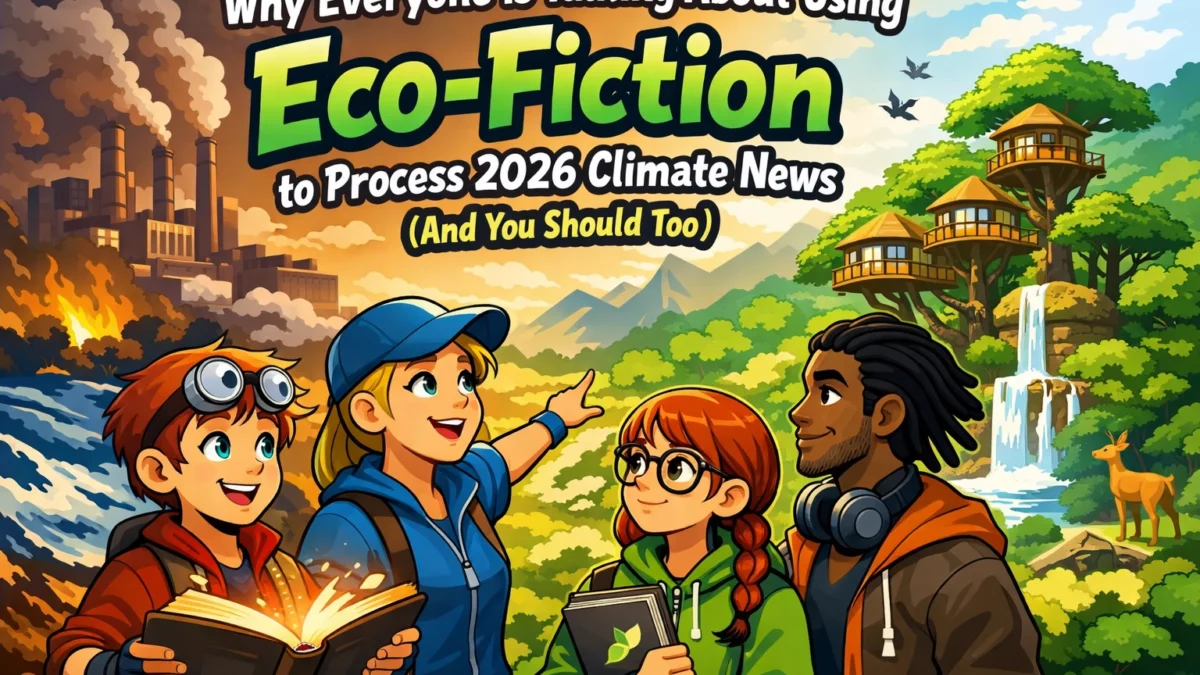
Caption: A team of eco-adventurers trekking through a vibrant, high-tech rainforest setting.
Why "Rewilding the Novel" is the Trend of 2026
There’s a term going around literary circles right now: "Rewilding the novel."
In the past, nature was just the background, the stage where the "important" human stuff happened. But in 2026, nature has become the main character. In modern eco-fiction, the environment isn't just a setting; it’s an active participant. It has a voice, a mood, and a very real impact on the plot.
At The Rainsavers, we lean into this hard. We believe that if you want to understand why rainforest adventures will change the way you think about superhero origins, you have to see the planet as something worth fighting for, not just a backdrop for a fight.
When the environment is a character, the "news" stops being a list of problems and starts being a story of survival and reclamation.
Dealing with "Climate Anxiety" Through High-Stakes Adventure
Let’s get real for a second. Climate anxiety is the defining feeling of 2026. It’s that low-level hum of "What can I even do?"
If you’re struggling with climate anxiety, traditional news can make you feel helpless. But fiction offers a "psychological bridge." It gives you a safe space to explore "what if" scenarios.
- What if we could use ancient technology to solve modern threats?
- What if a team of dedicated individuals could actually stop a global catastrophe?
By following The Rainsavers through their missions, you’re practicing hope. You’re seeing that while the threats are massive, they aren't invincible. It’s an emotional workout that leaves you feeling more prepared to face the real world.

Caption: An ancient stone temple hidden behind a waterfall, glowing with mysterious, sustainable energy.
The Power of the Team (Goodbye, Solo Superheroes)
One of the reasons people are flocking to eco-fiction right now is that it reflects the reality of how we’re going to save the world: together.
The days of the "lone wolf" hero are pretty much over in 2026 fiction. Why? Because one person can't fix a planet. It takes a team with different skills, different backgrounds, and different perspectives.
In The Rainsavers, we focus on the team dynamic. Whether they’re dealing with high-tech red mercury gadgets or tracking a villain through a dense jungle, they have to rely on each other. This resonates with us in 2026 because we know that our real-world environmental challenges require collective action, not a single person in a cape. If you’re curious about why this shift is happening, check out our thoughts on why team-based eco-adventures are dominating 2026 fiction.
Sci-Fi Tech vs. Natural Mystery
A lot of the 2026 news focuses on tech solutions: carbon capture, new energy sources, and AI monitoring. Eco-fiction takes these ideas and turns them into "What if?" adventures.
In our stories, we love mixing the high-tech with the historical. We ask: What if the answers to our modern problems were buried in ancient ruins? What if sci-fi tech, like the mysterious red mercury, could be harnessed for good (or used for absolute chaos by a motivated villain)?
This blend of ancient technology vs. modern threats keeps the stories exciting while making us think about the real-world tools we have at our disposal. It’s way more fun to read about a pulse-pounding chase through a hidden lab than it is to read a white paper on renewable energy patents.

Caption: A futuristic device made of gold and crystal, pulsing with a soft blue light.
How to Get Started with Eco-Fiction Today
If you’re feeling the weight of the world, don’t reach for the news app. Reach for a book. Here’s a quick guide to using fiction to reset your brain:
- Find a Character You Connect With: Are you a "boots on the ground" person like Primal? Or do you prefer the deep history and strategy of someone like Mortalis? Check out our character spotlights to find your entry point.
- Look for Hope, Not Just Disaster: There’s a subgenre called "cli-fi" that is often very dark and dystopian. While those have their place, we recommend looking for "eco-adventure." These are stories where action is taken and progress is made.
- Discuss the Themes: Join the conversation. Eco-fiction is a great conversation starter for friends who are also worried about the planet. It’s easier to talk about a character’s choices than it is to argue about policy.
The Rainsavers: Your 2026 Escape (and Inspiration)
At the end of the day, our goal at The Rainsavers is to give you a world you want to spend time in. We want to provide that thrill of adventure while reminding everyone that the planet is the most incredible setting we’ve ever been given.
So, the next time the 2026 news cycle starts to feel like a heavy fog, let us take you on a trip into the heart of the jungle. Let’s face the villains, solve the mysteries, and save the rain together.
Because why eco-fiction will change the way you think about adventure stories is simple: it reminds you that you’re part of a much bigger, much more beautiful story.

Caption: A lush, thriving forest under a clear sky, symbolizing a protected and healthy future.
Ready to dive in?
Explore our latest missions, meet the team, and find your next favorite read at The Rainsavers. Let’s turn that climate anxiety into adventure.
Visit us today at https://rainsavers.com and join the mission.
