
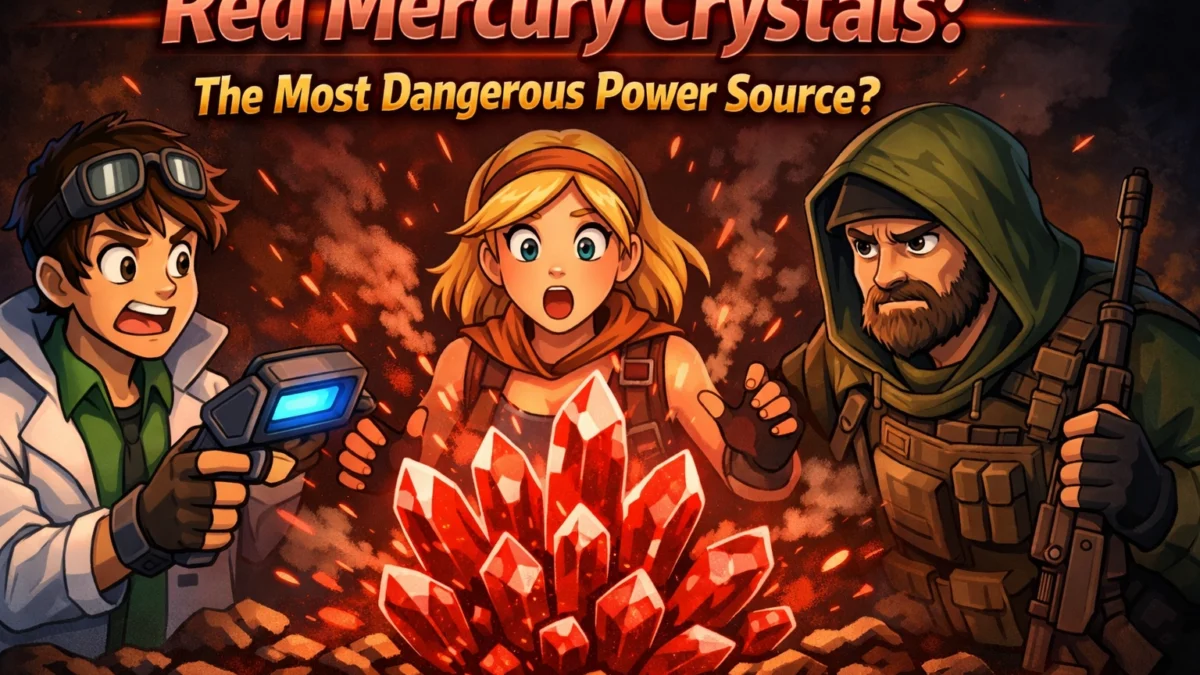
Meta Description: Red mercury doesn't exist in real life: but in fiction? It's terrifyingly perfect. We break down why this mythical power source makes such a compelling (and dangerous) plot device in 2026's best eco-adventure stories.

Here's a fun fact: red mercury doesn't actually exist.
Seriously. It's a complete hoax: a legend that originated in the Middle East as some kind of magical healing elixir supposedly extracted from Egyptian mummies. Then it morphed into Cold War paranoia about Soviet super-materials. Con artists made millions selling fake samples on the black market to people who genuinely believed they were buying the key to nuclear weapons or stealth technology.
Scientists who've analyzed "red mercury" samples? They found regular mercury, water, and common salts. That's it.
But here's the thing: Red mercury might be fake in the real world, but in fiction? It's chef's kiss perfect.
Why Fake Science Makes the Best Story Fuel
In 2026, we're living in an era where readers are smarter than ever. We've got fact-checkers in our pockets and Wikipedia on speed-dial. So why do fictional power sources like red mercury still work so well in stories?
Because the mythology is already built in.
Red mercury comes pre-loaded with decades of conspiracy theories, pseudoscience, and genuine fear. When you drop "red mercury crystals" into a narrative, readers immediately feel that electric thrill of danger: even if they know intellectually that it's nonsense. The cultural weight is already there. Writers just have to tap into it.

In The Rainsavers universe, red mercury crystals aren't just a MacGuffin or a glowing plot device. They're a representation of humanity's desperate scramble for power at any cost. When ancient technology meets modern greed, you get exactly the kind of environmental catastrophe that makes eco-adventure stories hit different.
The Danger Scale: How Does Red Mercury Stack Up?
Let's be real: fiction is full of dangerous power sources. Glowing rocks. Unstable elements. Mysterious energy cores. But what makes a power source truly dangerous in a narrative sense?
Accessibility: Can any random villain get their hands on it? Red mercury wins here because the mythology suggests it could be hidden anywhere: ancient tombs, abandoned Soviet facilities, black market dealers. It's not locked in some high-tech vault. It's out there, which ramps up the stakes immediately.
Instability: The best fictional power sources have a ticking-clock element. In stories featuring red mercury, the crystals are often depicted as volatile, radioactive, or capable of triggering catastrophic reactions. Perfect for third-act countdowns.
Moral Complexity: Here's where things get interesting. A dangerous power source isn't just physically threatening: it's ethically murky. If red mercury could solve an energy crisis or destroy a city, what do you do with it? The heroes in The Rainsavers face these kinds of impossible choices constantly.
Cool Factor: Let's not pretend aesthetics don't matter. Red mercury sounds cool. It looks cool. Glowing crimson crystals pulsing with unstable energy? That's visual storytelling gold.
The 2026 Twist: What If the Real Danger Is Us?
In older adventure stories, the power source was the villain. The radioactive asteroid. The alien technology. The cursed artifact. Destroy it, problem solved.
But modern eco-adventure fiction flips that script.

In 2026, readers understand that the real threat isn't the red mercury: it's what we do with it. Climate change, resource exploitation, corporate greed masquerading as innovation. These are the actual villains. Red mercury is just the match. We're the ones holding it next to gasoline.
The Rainsavers series leans into this hard. Sure, there are ancient mysteries and dangerous technologies, but the real conflict is always about human (and superhuman) choices. Do you use red mercury to power a city or weaponize it for profit? Do you bury the discovery or risk it falling into the wrong hands?
There's no easy answer, which is exactly why it makes for compelling storytelling.
Why We're Still Obsessed With "Forbidden" Power
Here's the uncomfortable truth: we want to believe in red mercury.
Not literally (hopefully). But we're drawn to the idea that somewhere out there, there's a secret power source that could change everything. Solve the energy crisis. Level the playing field. Give us an edge.
The persistence of red mercury myths: even in 2026, with all our scientific literacy: proves that we're hardwired for this kind of thinking. Social media is still full of fake videos showing "red mercury" demonstrations using simple video effects. People want it to be real.
Fiction taps into that yearning. When a story introduces red mercury crystals, it's not just about the plot: it's about our collective fantasy of secret knowledge and hidden power. And when that power turns out to be dangerous, unstable, and corrupting? That's just the universe reminding us why some doors should stay closed.

The Environmental Angle: When Power Sources Fight Back
The really clever thing about using red mercury in eco-adventure stories is the built-in environmental metaphor.
Think about it: red mercury is described as something pulled from the earth: whether from ancient Egyptian sources or Soviet mining operations. It's extracted, refined, weaponized. Sound familiar? It's basically the entire history of fossil fuels in crystalline form.
And just like real-world resource extraction, fictional red mercury leaves scars. Contamination. Destruction. Communities displaced or destroyed. The earth itself fighting back against those who would exploit it.
The Rainsavers understands this dynamic. The series doesn't just throw in red mercury for cool factor (though it is cool). It uses these dangerous power sources to explore our real-world relationship with energy, consumption, and planetary health. It's adventure fiction that makes you think: without feeling like homework.
So… Is Red Mercury the Most Dangerous Fictional Power Source?
Honestly? It's up there.
It's got the mythology, the visual appeal, the moral complexity, and the real-world resonance that makes for unforgettable storytelling. Whether it's glowing in an underground chamber or pulsing inside some villain's doomsday device, red mercury delivers exactly what modern readers want: high stakes, ethical dilemmas, and just enough pseudoscience to feel deliciously dangerous.
The beauty of fiction is that we get to explore these "what if" scenarios without the actual risk. We can watch heroes grapple with impossible choices involving red mercury, learn from their mistakes, and walk away entertained and maybe a little wiser about our own relationship with power and resources.
And if you're looking for stories that blend ancient mysteries, dangerous technologies, and genuine environmental stakes? You know where to find them.
Ready to dive into a world where every power source comes with consequences and heroes actually have to think before they act? Read Book One now and discover why The Rainsavers is redefining eco-adventure for a new generation.
