
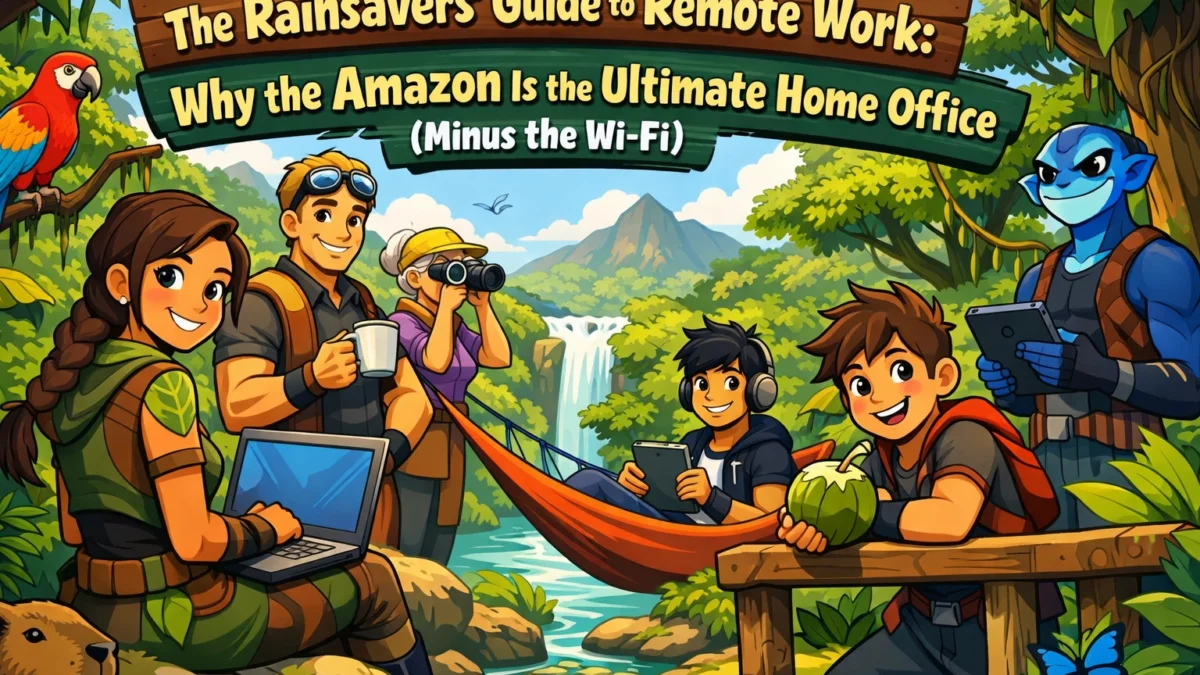
Meta Description: Tom Swift and the Rainsavers team prove the Amazon rainforest is the ultimate remote workspace, if you can handle the humidity, wildlife coworkers, and zero cell service. Read Book One now.
By 2026, remote work isn't just about working from your couch in pajamas anymore. For Tom Swift and the Rainsavers crew, "remote" means really remote, like, deep-in-the-Amazon-rainforest remote, where your daily standup includes actual standing (on a riverbank), your background noise is howler monkeys instead of a neighbor's lawnmower, and IT support means hoping Sunbyte hasn't fried another laptop with moisture.
Is the Amazon the world's most extreme home office? Absolutely. Would we recommend it for your average Zoom meeting? Hard no. But here's why it works for our team, and what you can learn from their high-stakes, high-humidity work setup.
Your Commute Is Now a Canoe Ride
Forget traffic jams. Tom Swift's morning commute involves navigating river currents, dodging caimans, and occasionally bailing water out of a dugout canoe. The upside? Zero carbon emissions. The downside? You might arrive at the "office" soaking wet and covered in mud.
In 2026, most remote workers complain about their 10-second walk from bed to desk. The Rainsavers? They're paddling upstream for 45 minutes just to reach base camp. It puts that Teams notification in perspective, doesn't it?

Pro tip from Tom: Waterproof everything. And we mean everything. Your laptop, your notes, your snacks. The Amazon doesn't care about your quarterly goals, it will flood them anyway.
The Conference Room Has Actual Wildlife
Sunbyte once tried to host a strategy session under the canopy. Five minutes in, a troop of spider monkeys crashed the meeting, stole someone's protein bar, and flung it into the river. The session was rescheduled.
When your office has no walls, you get surprise visitors. Parrots interrupt presentations. Jaguars occasionally wander past during lunch breaks. And don't even get us started on the ants, they're everywhere, and they don't respect personal boundaries.
But here's the thing: working alongside wildlife keeps you humble. You're not the main character in the Amazon. You're just another organism trying to survive the humidity and finish a task before the rain hits.
Wi-Fi? More Like "Why-Fi Would You Even Ask?"
Let's be real: the Amazon doesn't have Wi-Fi. Starlink is making inroads in some remote communities, but the Rainsavers' base camp? Nope. They're lucky if they get a single bar of satellite signal on a clear day.
Sunbyte, the team's tech wizard, has rigged together a Frankenstein setup involving solar panels, battery packs, and what he swears is "totally not illegal signal boosting." Does it work? Sometimes. Does it crash during crucial moments? Always.

The lack of constant connectivity forces the team to actually think before acting, plan ahead, and, wild concept, talk to each other face-to-face. No endless Slack threads. No "let me check my email real quick" excuses. Just humans solving problems in real time, the old-fashioned way.
Lesson learned: You don't need Wi-Fi to get work done. You need focus, resourcefulness, and a teammate who knows how to rewire a satellite modem using duct tape and optimism.
Your Coworkers Are Slightly Terrifying
Tom Swift's team isn't your typical corporate crew. These are people who willingly chose to work in one of the most dangerous ecosystems on Earth. They're brilliant, tough, and occasionally unhinged.
Take Sunbyte. Genius inventor? Yes. Socially well-adjusted? Debatable. The man once spent three hours arguing with a parrot about the structural integrity of his tech rig. The parrot won.
But that's the beauty of remote work in the Amazon, you can be weird, eccentric, and entirely yourself. No HR department is monitoring your Slack tone or asking you to "circle back" on synergy. You're just a team, solving problems, staying alive, and occasionally laughing at how absurd the whole situation is.
The Dress Code Is "Whatever Survives the Humidity"
Business casual? Not happening. The Amazon's dress code is tactical: moisture-wicking fabrics, sturdy boots, and about seventeen layers of bug spray. Tom Swift's "boardroom attire" includes cargo pants, a field respirator, and a machete.
Fashion takes a backseat when your office has a 90% humidity rating and a real chance of encountering venomous snakes. Function wins. Always.

But honestly? It's kind of liberating. No one cares if your shirt is wrinkled or if you wore the same pants three days in a row (spoiler: you did, because laundry facilities don't exist out here). You're judged on results, not appearance.
Hot take from the team: Every company should adopt the Amazon dress code. Life's too short for uncomfortable shoes.
"Work-Life Balance" Means Not Dying
In a typical remote job, work-life balance means setting boundaries, taking breaks, and logging off at 5 PM. In the Amazon, work-life balance means staying hydrated, not getting bitten by something venomous, and remembering to eat actual food instead of energy bars for the fifth day straight.
The stakes are higher. Tom and the crew aren't just managing deadlines, they're managing survival. That mission deadline isn't arbitrary; it's tied to weather patterns, supply drops, and the very real possibility of being stranded if they don't move fast enough.
And yet, there's something clarifying about it. When your "office" is a rainforest and your project literally impacts the environment around you, the work matters. You're not shuffling papers or optimizing funnels. You're solving real problems with real consequences.
The Break Room Is the Entire Rainforest
Need a mental reset? Step outside. Actually, you're already outside, that's the point. The Amazon is the ultimate break room.
Tom Swift swears by river swims during downtime (ignoring the piranhas, naturally). Sunbyte likes to tinker with abandoned tech in the shade of a massive ceiba tree. The whole team has learned to appreciate the absurd beauty of working in one of the most biodiverse places on the planet.

Sure, you can't order a latte from the break room. But you can watch the sunset paint the canopy in shades of gold and orange while howler monkeys provide the soundtrack. Not a bad trade-off.
Why This "Office" Actually Works
Here's the thing: the Amazon isn't just a cool backdrop. It's why the Rainsavers do what they do. Every mission, every invention, every close call with wildlife, it all ties back to protecting this place and the people who call it home.
Working in the Amazon keeps the team grounded (literally and figuratively). They see firsthand what's at stake. They're not fighting abstract threats from behind a screen, they're in it, boots-on-the-ground, solving problems in real time.
And yeah, it's chaotic. The Wi-Fi sucks. The bugs are relentless. Someone's always complaining about their wet socks. But it works because the mission is bigger than comfort. The Rainsavers aren't just remote workers: they're environmental protectors, innovators, and accidental comedians trying to save the world one humid, muddy day at a time.
The Takeaway (Besides Mosquito Bites)
You don't need to relocate to the Amazon to learn from the Rainsavers' work setup. But you can borrow a few lessons:
- Disconnect to reconnect. Less Wi-Fi might actually make you more productive.
- Embrace the chaos. Not everything goes according to plan. Roll with it.
- Work with purpose. When the mission matters, the obstacles become bearable.
- Your coworkers don't have to be conventional. Weird is good. Weird gets stuff done.
The Amazon might not be the right home office for everyone. But for Tom Swift, Sunbyte, and the rest of the Rainsavers crew? It's the only office that makes sense.
Want to see how they survive the humidity, outsmart the wildlife, and occasionally argue with parrots while saving the world? Read Book One now and meet the team that turned the Amazon rainforest into the ultimate high-stakes workplace.
