Meta Description: Discover how high-tech gadgets and ancient mysteries save the planet. Explore the world of The Rainsavers where sci-fi meets green tech in the ultimate 2026 adventure.
Hey everyone, Steven G. Samuels here. If you’re like me, you’ve probably noticed that the "future" doesn't look quite like it used to. Back in the day, sci-fi was all about chrome hallways, sterile spaceships, and maybe a laser gun that went pew-pew. But it’s 2026 now, and the vibe has shifted.
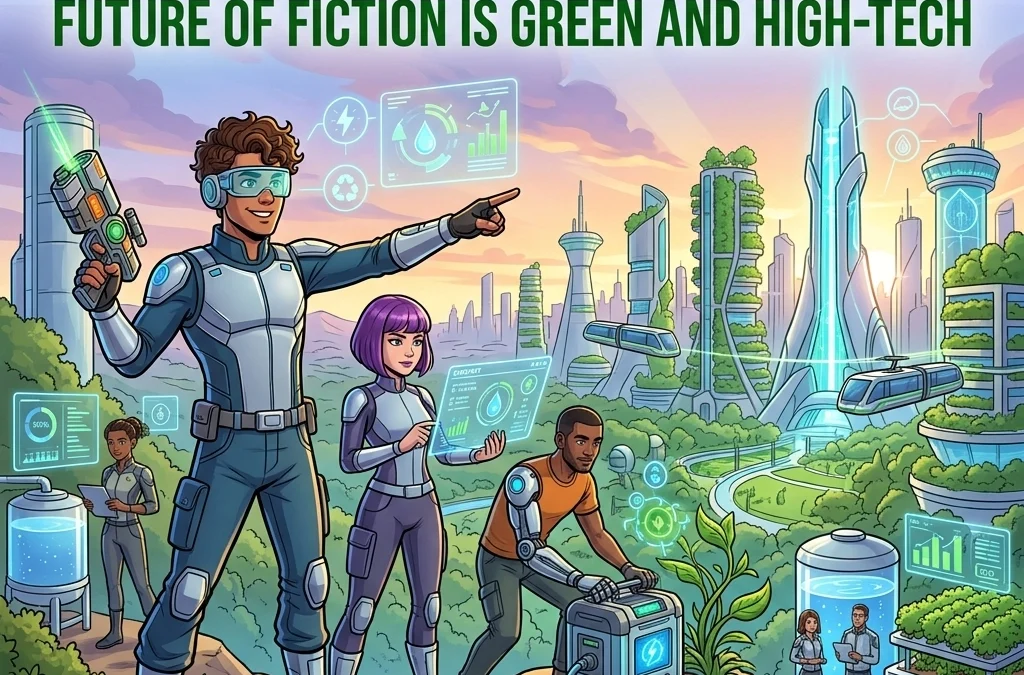
The future is looking a lot more… green. And I don’t just mean "save the whales" green. I mean high-tech, bio-integrated, ancient-mystery-infused green.
You’ve got three minutes? Great. Let’s break down why Science Fiction Environmentalism (or Eco-Sci-Fi, if you’re into the whole brevity thing) is the most exciting thing happening in publishing right now, and why we’re betting the farm on it here at The Rainsavers.
The "Speed-Run" Explanation (0:00–1:00)
In the past, environmentalism in stories was usually a downer. It was all about the apocalypse, the "dry world," or the "drowned world." It was "Cli-Fi" (Climate Fiction) that made you want to hide under your covers.
But Science Fiction Environmentalism flips the script. Instead of just mourning what’s lost, it asks: What if we used the coolest tech imaginable to fix it?
It’s the intersection where high-octane adventure meets planetary restoration. It’s about heroes who don’t just punch villains; they solve ecological puzzles using gadgets that would make a Silicon Valley CEO weep with envy. At its core, it’s about the belief that nature and technology aren't enemies, they’re potential best friends.
Why It’s Taking Over in 2026 (1:00–2:00)
Why now? Because we’re living it. In 2026, we aren't just talking about climate change; we’re seeing the rise of real-world green tech. Our fiction is finally catching up. People are tired of solo superheroes flying around in capes solving nothing. They want teams. They want solutions. They want stories that feel like they could actually happen if we just found the right "spark."
In our series, The Rainsavers, we take this to the next level. We don’t just give you a hero; we give you a team working against the clock to protect the world's most vital resources. It’s not just about stopping a "bad guy", it’s about outsmarting systems that threaten the planet.

The "High-Tech" Secret Sauce (2:00–3:00)
This is where it gets fun. Sci-fi environmentalism isn't just about planting trees. It’s about Spirit Trees that hold biological data. It’s about holographic mapping of rainforest canopies. It’s about using ancient technology, recovered from long-lost civilizations, to solve modern-day threats.
When you mix historical mysteries with cutting-edge sci-fi, you get a cocktail of adventure that’s impossible to put down. It’s why ancient technology vs. modern threats makes for such a killer narrative. It bridges the gap between where we came from and where we’re going.
The "Director’s Cut": A Deeper Look into the Green Tech Revolution
Okay, so maybe that was the three-minute version. But if you’ve got a little more time, let’s go "down the rabbit hole." (And hey, if you really want to go deep, check out our Down the Rabbit Hole contest!)
The truth is, we’ve reached a point where "generic" sci-fi feels a bit hollow. We’ve seen the Death Stars. We’ve seen the cyberpunk dystopias. What we haven't seen enough of, until now, is a future that we actually want to live in.
Nature as the Ultimate Tech
At The Rainsavers, we view the environment not as a backdrop, but as a character. When Leonard West or the rest of the crew steps into a rainforest, they aren't just walking through woods. They are walking through a biological supercomputer.
Think about it: A single leaf is a solar-powered factory. A root system is a decentralized communication network. When you start looking at nature through a sci-fi lens, the storytelling possibilities are endless. This is why rainforest adventures are changing the way people think about superhero origins. Forget gamma rays; give me a symbiotic relationship with a prehistoric plant any day.

The "Team" Dynamic vs. The "Solo" Hero
One of the biggest shifts in Science Fiction Environmentalism is the move away from the "chosen one." Saving a planet is a big job, too big for one guy in spandex. That’s why we focus on team-based adventures.
It takes a village (or at least a very specialized tactical team) to save an ecosystem. You need the tech genius, the historian, the muscle, and the visionary. This shift reflects our real world. We know that global challenges require global cooperation. Plus, it makes for way better banter. If you’re wondering why team-based adventure series are taking over, it’s because we’re all craving that sense of community right now.
LEAKED: Leonard West’s Personal Tech Journal (Entry #42)
“Samuels keeps asking me to simplify the Spirit Tree leaf interface. He says, ‘Leonard, make it look cool.’ I told him it’s not about looking cool; it’s about the fact that this leaf is currently processing 4 terabytes of ecological data per second using nothing but photosynthesis and a bit of ancient German engineering we recovered from that 1940s wreckage. If he wants ‘cool,’ I’ll add some blue LEDs to the hologram. Oops, dropped my coffee on the projector. Note to self: Holographic leaves do not like dark roast.”
The Villain Motivation Shift
In traditional sci-fi, villains want to "rule the world." Boring. In Eco-Sci-Fi, the villains are often more complex. They might be trying to hoard resources, or they might believe that the only way to save the planet is to remove the humans from the equation.
When you pit ancient mysteries against modern threats, you get villains with motivations that actually make you stop and think. They aren't just "evil"; they’re misguided visionaries. That makes the conflict feel much more personal and much more dangerous.

Why You Need This on Your Reading List
If you’re feeling a bit of that 2026 "climate anxiety," you aren't alone. But stories shouldn't just remind you of what’s wrong; they should inspire you with what could be.
The Rainsavers is a 6-book adventure series designed to be the antidote to that stress. It’s fast-paced, it’s funny, and it’s packed with the kind of green tech that makes the future look bright again. If you’re struggling with climate anxiety, jumping into a world where heroes are actually winning the fight is a great place to start.
We’ve put together a list of 10 adventure series that will save your reading list, but obviously, we’re a little partial to our own crew.
The Bottom Line
Science Fiction Environmentalism is here to stay because it’s the only genre that’s actually looking at the world we live in today and saying, "Yeah, we can work with this." It’s green, it’s high-tech, and it’s a hell of a lot of fun.
So, are you ready to see what the future actually looks like?
See the future at rainsavers.com.

Quick Poll: What Tech Would You Want?
Before you go, we’re running a little experiment over on our poll page. If you could have one piece of Rainsaver tech, would it be:
- The Holographic Spirit Leaf (Data at your fingertips)
- The Carbon-Sync Drones (Clean air on the go)
- The Ancient German Bio-Engine (Infinite green energy)
Head over and let us know! And if you want to see the gear in action, don't miss our latest TV commercial: it’s got more explosions (and trees) than you can shake a stick at.
Stay curious, stay green, and keep reading.
: Steven G. Samuels, CEO, The Rainsavers
