
Meta Description: Is Red Mercury real or just the ultimate villain MacGuffin? Penny dives into the science, the scams, and the high-stakes mystery behind 2026’s favorite high-tech fiction trope.
Hey there, mystery seekers! Penny here.
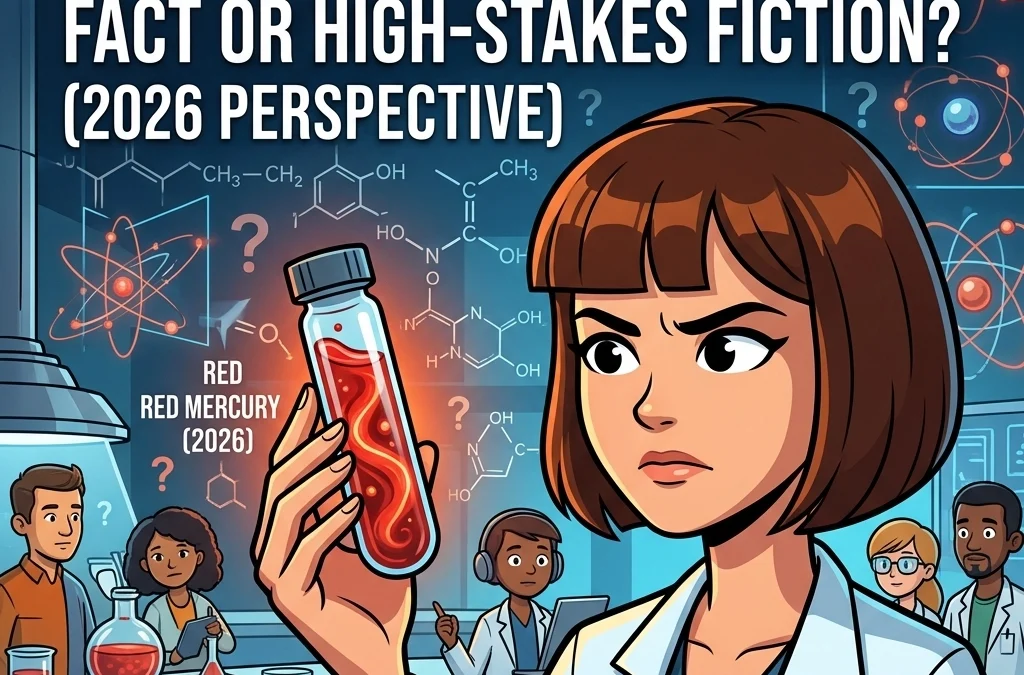
If you’ve been hanging out in the darker corners of the internet lately, or just binging the latest high-stakes thrillers, you’ve probably heard whispers of a substance so powerful it could either jumpstart a cold fusion reactor or level a city. It’s mysterious, it’s elusive, and it’s always, always bright red.
I’m talking about Red Mercury.
Is it a secret Soviet invention? A shortcut to nuclear fusion? Or just the most successful urban legend in the history of global espionage? As we cruise through April 2026, the myth of Red Mercury is still alive and kicking, showing up in villainous manifestos and Reddit threads alike. But here at The Rainsavers, we like to peel back the curtain. Is there any actual science here, or are we just looking at the ultimate "MacGuffin"?
The Red Mystery: What is it supposed to be?
In the world of fiction (and some very sketchy black-market deals), Red Mercury is described as a cherry-red, gooey liquid with a density that defies gravity. The stories claim it has incredible properties: it’s a catalyst for nuclear fusion, it can "dissolve" stealth coatings, or it’s a vital component for high-precision weaponry.
Some even say it’s an ancient technology rediscovered, a classic trope we love to explore when debating ancient mysteries vs. modern threats.
But here’s the kicker: if you try to find "Red Mercury" on the periodic table, you’re going to be looking for a long time. Spoiler alert: it’s not there.

The Lab Report: Chemistry or Conjuring?
Let’s get real for a second. Scientifically speaking, Red Mercury is widely considered a hoax.
Research from the last few decades confirms that no legitimate scientific institution has ever verified the existence of a substance with these properties. Most "Red Mercury" seized in real-world sting operations turns out to be nothing more than mercury iodide, mercury oxide, or even red dye mixed with ordinary mercury. Sometimes it’s just red paint.
So, why does the myth persist in 2026?
- Complexity: Most people don't understand nuclear physics (I certainly have to ask Alpha Orangenius for help on that!). This makes it easy for scammers and writers to hide behind "classified science."
- The Allure of the Secret: We love the idea that there’s a "cheat code" for technology out there.
- The "Scam-ability" Factor: Scammers use the secretive nature of the material to trick people into paying millions for a vial of red liquid. If you can’t tell anyone you’re buying it because it’s "illegal," you can’t exactly call the police when it turns out to be food coloring.
Why Villains Love a Good Hoax
In our world of environmental thrillers, Red Mercury is the perfect tool for a villain. Why? Because a villain doesn't actually need the science to work, they just need people to believe it works.
Think about it. A shadowy corporation trying to extort world leaders doesn’t need a working fusion bomb if they have a vial of "Red Mercury" and a really good PR team. It creates immediate, high-stakes tension. It’s the kind of threat that requires a specialized team, like The Rainsavers, to step in.
We’ve found that mixing historical mysteries with modern sci-fi creates threats that feel much more dangerous than your average generic bad guy. Whether it’s "ancient Nazi tech" or a mythical chemical compound, the mystery is what keeps the pages turning.

Red Mercury in 2026: Why It Still Haunts Our Feeds
You’d think that by 2026, with all our advanced AI and instant fact-checking, we’d have put this to bed. But the internet is a funny place. The myth has evolved. Now, people link Red Mercury to "zero-point energy" or "nano-tech breakthroughs."
It has become a symbol of the "unknown threat." In an era where we’re dealing with real-world climate anxiety, these fictional "super-substances" provide a tangible thing to fight. It’s much easier to stop a villain with a red vial than it is to stop systemic deforestation.
That’s why our stories focus on the modern eco-heroes. They deal with the tech, but they also deal with the reality behind it.
How The Rainsavers Tackle High-Tech Myths
When a rumor about a "Red Mercury" shipment hitting the Amazon rainforest pops up, our team doesn't just panic. They use their unique skills to debunk the myth and stop the real danger.
- Sunbyte, our hacker extraordinaire, tracks the digital breadcrumbs of the scammers. (You can meet Sunbyte here!)
- Primal provides the muscle if the "negotiations" get heated. (Check out Primal’s origin story.)
- Jungle Dart ensures the team stays one step ahead in the thick of the canopy. (Get to know Jungle Dart here.)
We’ve realized that team-based adventure series are the best way to handle these complex mysteries. One person can’t know everything, but a team can cover the science, the tech, and the boots-on-the-ground action.

Fact vs. Fiction: The Verdict
So, is Red Mercury real?
- In the lab? No.
- In the black market? It’s a scam.
- In the world of fiction? It’s 100% real and 100% dangerous.
Fiction allows us to explore the "what ifs." What if a substance like that did exist? How would it change the balance of power? How would it affect our planet’s fragile ecosystems? These are the questions that drive our 6-book adventure series.

Join the Adventure
If you love the thrill of the chase, the shimmer of high-tech mysteries, and the heart-pounding action of heroes fighting for the planet, you’re in the right place. The world of The Rainsavers is full of "Red Mercury" moments: where science, myth, and danger collide.
Ready to see how a real team handles high-stakes fiction? Start your journey with us today.
Explore the world of The Rainsavers and see if you can spot the fact from the fiction!
Click here to dive into the adventure!
Stay curious, stay skeptical, and keep reading!
( Penny 🖋️)
