
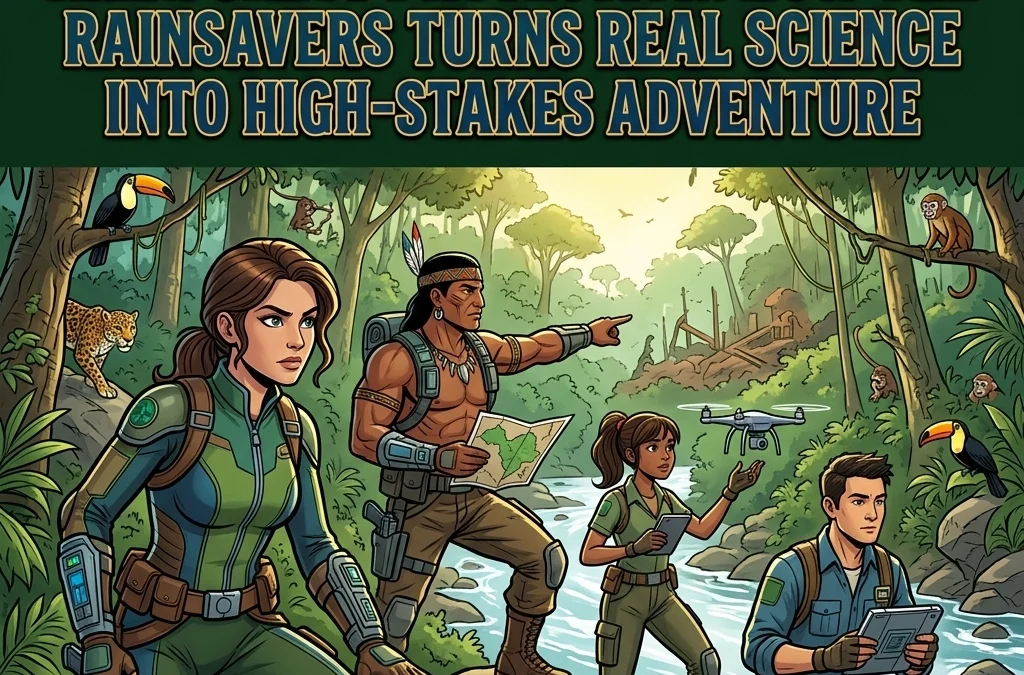
Let’s be real for a second: the news about the environment can be a total buzzkill. You open a tab, see a headline about the Amazon reaching a "tipping point," and suddenly you want to crawl under your desk and stay there until 2050. We get it. At The Rainsavers, we believe that while the facts are heavy, the way we talk about them doesn’t have to be.
In fact, we think the best way to save the world is to make sure people actually want to be in it. That’s why we’ve taken the gritty, fascinating, and sometimes terrifying science of Amazon rainforest protection and wrapped it in a high-octane explosive shell of science fiction environmentalism.
So, how exactly do we turn real-world ecological data into a heart-pounding adventure? Pull on your hiking boots, watch out for the bullet ants, and let’s dive into the jungle.
The Science of the "Tipping Point" (And Why It’s Our Favorite Plot Device)
In the real world, scientists are worried about the Amazon’s hydrological cycle. Basically, the forest creates its own rain. The trees "sweat" (transpire), the moisture forms clouds, and the clouds dump water back down. If you cut down too many trees, the cycle breaks. This is what scientists call the "tipping point."
In the world of The Rainsavers, we don’t just talk about the tipping point; we make it the ticking clock. Our characters aren't just fighting "bad guys", they are fighting a literal atmospheric collapse. When Sunbyte, our resident tech wizard, looks at a satellite feed, he’s not just seeing green pixels; he’s seeing the life support system of the planet flickering out.
By using real-world data about deforestation rates, like the fact that Brazil has already lost 20% of its rainforest, we give our villains, like the mysterious forces searching for ancient tech, a reason to be truly dangerous. If they win, the forest doesn't just go away; the world stops breathing.

Meet the Team: Real Science, Enhanced Personalities
Every hero needs a specialty. In The Rainsavers, those specialties are grounded in actual disciplines required for Amazon rainforest protection, just… dialed up to eleven.
Dr. Mubari: The Flora Whisperer
Dr. Mubari isn’t just a scientist; she’s a botanical ninja. Her character is inspired by the real-world study of the "Wood Wide Web", the mycelial networks that allow trees to communicate and share nutrients. In our series, she uses this science to navigate the densest parts of the jungle, identifying medicinal plants that could cure diseases or, you know, create a temporary smoke screen when you’re being chased by mercenaries.
If you want to know more about how our heroes stack up against the classics, check out our post on how modern eco-heroes are saving both fiction and the planet.
Alpha: Primate Power with a Purpose
Okay, we’ll admit it: Alpha, our 400lb orangutan, is a bit of a scientific stretch for the Amazon (orangutans are technically from Southeast Asia, but Alpha’s backstory is… complicated). However, his role in the team highlights a very real scientific fact: animal intelligence and their role as "gardeners of the forest." Alpha represents the biodiversity we are fighting to protect. Plus, having a massive primate who can tear the door off a humvee is just objectively cool.
Sunbyte: Cybersecurity in the Canopy
In the real world, groups like the "Amazon We Want" initiative use real-time monitoring and satellites to track illegal logging. Sunbyte takes that tech and weaponizes it. Whether he’s hacking into rogue German WWII-era frequencies or redirecting a weather satellite to pinpoint a hidden base, his character shows that the battle for the environment is being fought in the digital world as much as the physical one.

High-Tech Mystery: The German Connection
One of the most fun parts of writing The Rainsavers is blending historical mysteries with modern ecology. We’ve all heard the legends of "hidden cities" or "lost gold" in the Amazon. But what if the secret wasn't gold? What if it was high-level German technology from the 1940s that was designed to manipulate the very environment itself?
Using the historical context of German expeditions into South America, we’ve created a "what if" scenario that fuels our ancient technology vs. modern threats narrative. It’s not just sci-fi for the sake of sci-fi; it’s a way to explore how humans have always tried to control nature, and how our team has to stop that cycle of exploitation.
Why Science Fiction Environmentalism is the Future
Let’s be honest: a 500-page white paper on carbon sequestration is important, but it’s not exactly a page-turner. Science fiction environmentalism allows us to take those vital concepts and put them into a context where people actually care about the outcome.
When you’re reading about a high-stakes chase through a burning section of the rainforest, you’re experiencing the tragedy of deforestation in a visceral way. You aren't just a spectator; you're part of the team. This kind of storytelling is a powerful tool for processing climate anxiety. It turns that "I can't do anything" feeling into "I want to see the bad guys get what’s coming to them."

Turning Fact into Fiction: A Day in the Writer's Room
When we sit down to write a new episode, we usually start with a "Did you know?"
- Did you know that some trees in the Amazon can pump 1,000 liters of water into the atmosphere a day? Okay, let’s make a scene where the team uses that sudden humidity to hide from thermal sensors.
- Did you know there are still uncontacted tribes living deep in the jungle? Let’s explore the ethical dilemma of protecting their land without interfering with their culture.
- Did you know that certain fungi can break down plastic? Maybe Dr. Mubari has a "lab accident" that creates a weaponized version of that. (Oops!)
This "science-first" approach ensures that even when things get crazy (and they always do), there’s a kernel of truth at the center of the madness. It makes the world of The Rainsavers feel lived-in and urgent.
How You Can Join the Mission (Without Getting Muddy)
You don’t have to wrestle a caiman to help with Amazon rainforest protection. While our books are fiction, the stakes are real. Here is how you can engage with the world we’ve built:
- Read the Series: Start your journey at rainsavers.com and meet the characters who are taking a stand.
- Vote in Our Polls: Head over to our poll page and tell us which piece of tech or which jungle creature you want to see in the next book.
- Enter the Contest: Feeling lucky? Join the Down the Rabbit Hole Contest for a chance to win some epic Rainsavers gear.
- Educate Yourself: Use our Ultimate Guide to Climate Fiction to find more stories that turn environmentalism into entertainment.

Final Thoughts: The Forest is Watching
At the end of the day, The Rainsavers is about hope. It’s about the idea that even when the odds are stacked against us: even when the forest is burning and the villains have better tech: a small, dedicated team can make a difference.
The Amazon is more than just a setting for our books; it’s the heart of the planet. By mixing real science with high-stakes adventure, we hope to inspire a new generation of readers to look at the rainforest not as a distant problem, but as a treasure worth fighting for.
So, are you ready to save the rain? The adventure is just beginning.
Check out the full series and grab your gear at the Rainsavers Shop!
