
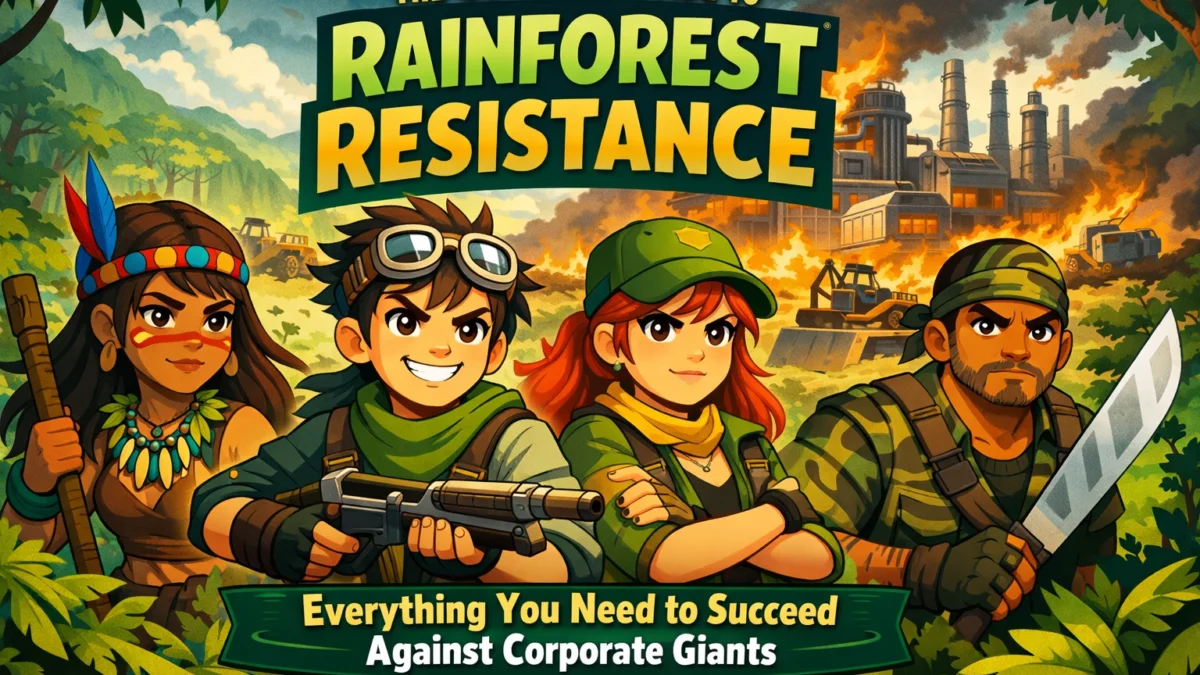
Meta Description: Master the art of rainforest resistance in 2026. Learn tactical maneuvers, community solidarity, and high-tech survival with Tom "Primal" Swift and Jungle Dart in this ultimate guide to taking down corporate giants.
Hey there, eco-warriors and adventure seekers. Steven G. Samuels here, CEO of The Rainsavers.
It’s Friday, February 27, 2026, and if you’ve been paying attention to the news lately, you know the "Green Rush" hasn’t slowed down. Corporate giants are still trying to pave over the lungs of our planet for a few extra zeros on their quarterly reports. But here at The Rainsavers, we don’t just write about heroes, we believe in the strategies that actually work when the suits come knocking on the canopy.
Whether you're a fan of our latest books or someone looking to understand how the "little guy" stands up to a trillion-dollar bulldozer, this guide is for you. We’re diving deep into the tactics used by the world’s most effective resistance movements, with a few survival tips from our very own Tom "Primal" Swift and the ever-elusive Jungle Dart.
1. The Power of "We" (Solidarity is Your Best Armor)
If there’s one thing we’ve learned by 2026, it’s that a lone hero makes for a great story, but a united community makes for a brick wall. Corporate giants win when they can isolate people. They offer "development" to one village while ignoring the next, hoping to spark a feud.
The Strategy:
- Coordination: Successful resistance movements thrive on regional and international solidarity. You need to build trust at the ground level before the first bulldozer even arrives.
- Information Sharing: In places like Tanzania and Sierra Leone, communities have successfully fought off land grabs simply by sharing their stories. When one village says, "Hey, this company promised us schools but only gave us polluted water," the next village knows to say "No thanks."
- Rejecting Divided Governance: Don’t let them pick your leaders for you.
As Tom "Primal" Swift always says: "One man can hold a ridge, but a village can hold a continent." You can find more about Primal’s philosophy on our characters page.
2. Territorial Demarcation: Drawing the Line
You can’t defend what you haven’t marked. One of the most effective strategies used by Indigenous groups, like the Huaorani in Ecuador, is physical demarcation. They didn't just sign papers; they planted 100,000 native palm trees along a 130-kilometer corridor to show exactly where their territory began.
The 2026 Tactical Twist:
In the world of The Rainsavers, we take this a step further. It’s not just about palms; it’s about visibility. When corporate scouts see a clearly marked, well-maintained boundary, they know they’re entering a zone of resistance.

Image description: A dense jungle boundary line marked by bioluminescent markers and tactical signage, with a high-tech field respirator hanging from a branch in the foreground.
3. High-Tech Survival: Gear of the Resistance
In 2026, the environment isn’t always friendly: especially when corporate "clean-up" crews start using chemical defoliants or "security" drones. To succeed against the giants, you need the right gear.
The Jungle Dart Essentials:
If you want to move like Jungle Dart, you need to think about stealth and protection.
- High-Tech Field Respirators: Essential for when the air gets thick with more than just humidity. Modern field respirators are lightweight and allow for full communication.
- Tactical Bio-Gear: Camouflage that doesn't just hide you from the human eye, but from thermal sensors.
- Signal Jammers: If they can’t see you on their satellite feed, they can’t target you.
Jungle Dart doesn't wear a superhero cape (and honestly, superhero stories are evolving anyway). He wears gear that keeps him alive long enough to pull the plug on a corporate server.
4. Indigenous Leadership and Knowledge
Let’s be real: nobody knows the rainforest better than the people who have lived there for generations. Indigenous-led conservation consistently outperforms government-run national parks. Why? Because they have a vested interest in the land's survival.
How to Support the Movement:
- FPIC (Free, Prior, and Informed Consent): This is the gold standard. If a company doesn't have it, they are intruders.
- Women’s Collectives: In regions like India’s Korchi, women have been the backbone of resisting mining projects, establishing new ways to manage forests that the "suits" never saw coming.
5. Community-Based Surveillance: Eyes Everywhere
You don't need a billion-dollar satellite network to monitor a forest. You need people. Community-led surveillance is one of the most effective ways to stop illegal logging and mining before it starts.
The Primal Approach:
Tom "Primal" Swift doesn't just sit in a tree; he sets up "The Web."
- Human Guides: Using local knowledge to track movements.
- Acoustic Monitoring: High-tech "ears" that can hear a chainsaw from miles away and alert the resistance instantly.
- Revenue Sharing: When the local community benefits from the forest (through eco-tourism or ecosystem payments), they become the world's best security force.

Image description: Tom "Primal" Swift crouched in a jungle thicket, wearing tactical gear and checking a holographic map of the surrounding forest, avoiding any superhero logos.
6. Controlling the Narrative
Corporate giants have massive PR machines. They will tell the world they are "harvesting responsibly" or "providing jobs." The resistance needs to tell the truth.
Tips for Winning the PR War:
- Document Everything: Use those smartphones and drones. High-definition footage of illegal clearing is harder to ignore than a press release.
- International Networks: Link up with groups like the Rainforest Action Network to get your story out to the global stage.
- Tell Human Stories: People don't care about "land parcels." They care about families, history, and the future of the planet.
Why This Matters in 2026
We’re at a turning point. The fiction we write at The Rainsavers isn't just about explosions and narrow escapes: it's about the very real struggle for our planet's future. When you read about Tom "Primal" Swift and Jungle Dart taking on the fictional "Apex Corp," you’re seeing a reflection of the real-world courage found in the Amazon, the Congo, and Southeast Asia.
We love a good adventure, but we love a living planet even more. That’s why we focus on team-based adventure. No one person can save the world, but a team with a plan? That’s a corporate giant’s worst nightmare.

Image description: A tactical team of diverse eco-adventurers moving through a mist-covered rainforest, equipped with respirators and high-tech gear, looking focused and determined.
Final Field Notes from Steven
If you’re feeling inspired to join the resistance: even if it’s just through the pages of a book: you’re in the right place. The world needs more people who aren't afraid to get their boots muddy.
The corporate giants might have the money, but we have the heart, the history, and the high-tech respirators.
Ready to see the resistance in action?
Read Book One now at rainsavers.com
Stay wild, stay tactical, and remember: the canopy always wins in the end.
: Steven G. Samuels
CEO, The Rainsavers
Want to dive deeper into the world of eco-adventure? Check out our latest episodes or see how our stories compare to ancient mysteries vs modern threats.
