
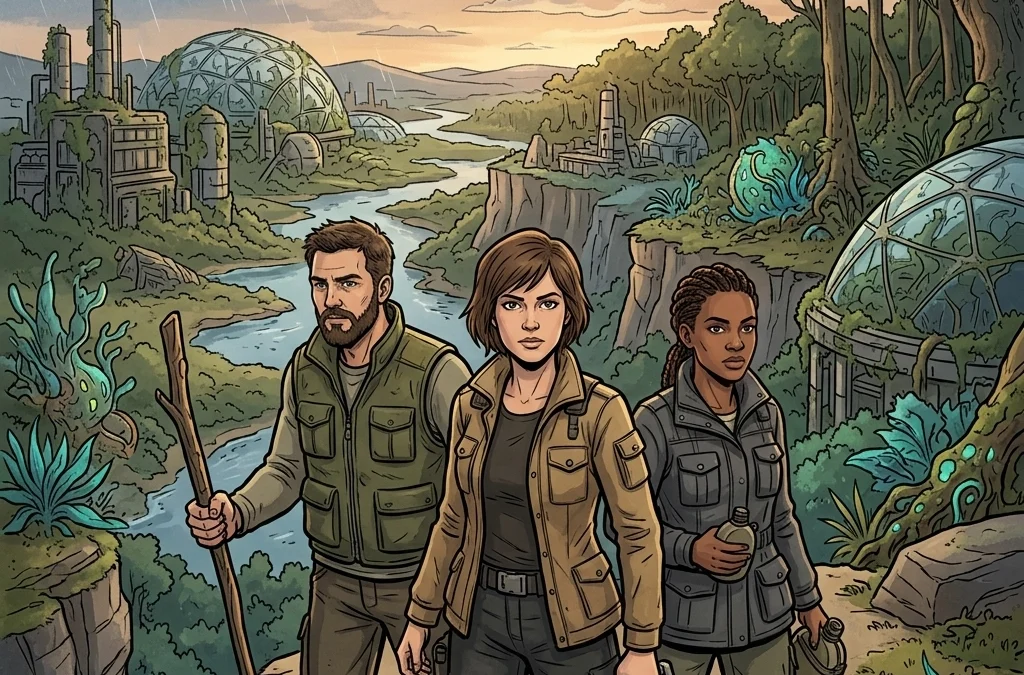
Meta Description: Sci-fi environmentalism is evolving. Discover why a 6-book action-adventure series like The Rainsavers is the perfect way to explore climate themes through high-octane gadgets, ancient mysteries, and tactical survival.

Let’s be honest: for a long time, "environmental science fiction" was just a fancy way of saying "a very depressing book about how we’re all doomed." You know the ones. Lots of grey skies, everyone is hungry, and the main character spends three hundred pages staring at a dried-up lake.
But it’s April 2026, and the world has changed. We’re tired of the doom-scrolling. We want adventure. We want gadgets. We want heroes who don’t just mourn the planet, they fight for it with high-tech respirators and tactical gear.
That’s where the 6-book series format comes in. Specifically, why a series like The Rainsavers is flipping the script on how we digest eco-fiction. It’s not just a story; it’s a tactical deployment into the heart of what science fiction environmentalism can actually be.
Why Six is the Magic Number
Most movies or standalone novels have to rush the "saving the world" part. You get introduced to a threat, someone finds a magical MacGuffin, and boom, credits roll. But environmentalism isn’t a one-and-done fix. It’s a marathon through a jungle filled with things trying to eat you.
A 6-book arc allows for something special: Escalation.
- Book One: You’re just trying to survive the humidity and figure out why your respirator is leaking.
- Book Three: You realize the "natural" disaster you’re fighting might actually be a piece of ancient German technology buried in the rainforest.
- Book Six: You’re leading a global movement to rewire the planet’s atmosphere before the clock hits zero.
When you have six books to play with, the "science" in science fiction actually gets room to breathe. You can explore the mechanics of how the world works, and how it breaks.
The "Cool" Factor: Tactical Eco-Adventure
We need to talk about the aesthetic. For too long, the "eco-hero" was portrayed as someone in a hemp tunic. In 2026, the eco-hero looks like a spec-ops operative. We’re talking high-tech field respirators, moisture-wicking tactical suits, and drones that can map a rainforest canopy in seconds.

Alt Text: A close-up of a high-tech field respirator resting on a topographical map of a dense jungle, surrounded by survival gear.
Science fiction environmentalism is at its best when it merges the organic with the mechanical. It’s about using cutting-edge tech to protect ancient ecosystems. When you read an action-adventure series that spans six volumes, you get to see that tech evolve. You see the gear get beat up, repaired, and upgraded. It makes the mission feel real. It makes the stakes feel heavy.
A Quick Memo from the CEO’s Desk
From: Steven G. Samuels
To: The Rainsavers Readership
Subject: Why we’re doing this.
"Hey everyone, Steven here. I’ve been asked a lot lately why we didn't just stop at one book. 'Steve,' they say, 'isn't one jungle trek enough?' Absolutely not. To really understand the scope of what we’re facing, both in fiction and reality, you need the long game. You need to see the team fail in Book Two so that their victory in Book Five actually means something. Plus, I just really like writing about tactical respirators. They look cool, okay? Stay hydrated out there."
Breaking the "Preachy" Barrier
The biggest hurdle for environmental fiction has always been the "preachiness." Nobody wants to be lectured for twelve hours.
The 6-book action-adventure format solves this by burying the message in the adrenaline. You aren't reading a thesis on carbon sequestration; you’re reading about a team of experts trying to stop a villain who is using ancient technology to weaponize the weather.
When the environmental "message" is the literal floor the characters are standing on, it becomes part of the stakes. If the forest dies, the characters die. If the air becomes toxic, the mission fails. It turns climate anxiety into a puzzle that can be solved with a bit of grit and a lot of high-explosives.
Teamwork Makes the (Eco) Dream Work
In a single book, you usually get one "Chosen One." But in a 6-book series, you get a squad. Science fiction environmentalism is shifting toward the idea that no one person can save the world. It takes a team: a medic, a tech specialist, a pilot, and maybe a grumpy veteran who knows too much about 1940s German engineering.
We’ve talked before about why solo hero stories are dying, and it’s especially true in eco-fiction. The environment is a "big boss" that requires a full party to defeat. Watching these characters interact over six books: their jokes, their "oops" moments (like that time Leonard accidentally set the bio-sensor to 'Polka' mode): makes the mission feel human.

Alt Text: A group of diverse adventurers in tactical gear sharing a laugh around a holographic map in a dimly lit jungle outpost.
The "Oops" Factor: Field Notes from the Front Lines
Excerpt from Leonard West’s Private Log (Recovered April 2026):
"Note to self: High-tech respirators are great until you try to eat a protein bar without taking it off. I’ve spent the last twenty minutes trying to scrape chocolate out of the intake valve while a jaguar watched me with what I can only describe as 'judgmental' eyes. This is the 'science' part of sci-fi they don't put in the movies. Saving the rainforest is 10% heroism and 90% trying not to trip over your own gear."
Why This Changes Your Thinking
When you finish a 6-book series like this, you don't look at the world the same way. You start seeing the "adventure" in sustainability. You start wondering what kind of tech we’re going to need to fix the messes we’ve made.
It moves the needle from "The world is ending" to "The world is a mission." And every mission needs a team, a plan, and a really good pair of boots.
Science fiction environmentalism isn't about the end of the world anymore. It’s about the beginning of the fight. It’s about the modern eco-heroes who are willing to go into the darkest parts of the jungle to turn the lights back on.

Alt Text: A breathtaking wide shot of a futuristic city integrated perfectly into a massive, thriving rainforest canopy.
Ready to Join the Mission?
If you’re tired of the same old "doomsday" tropes and you want to see what happens when environmentalism gets an action-adventure makeover, there’s only one place to start.
The world isn't going to save itself, and neither are these books. It’s time to gear up, check your oxygen levels, and dive into a series that treats the planet like the ultimate adventure.
Read Book One now at The Rainsavers and see why the next six books will change everything you thought you knew about the future.
