
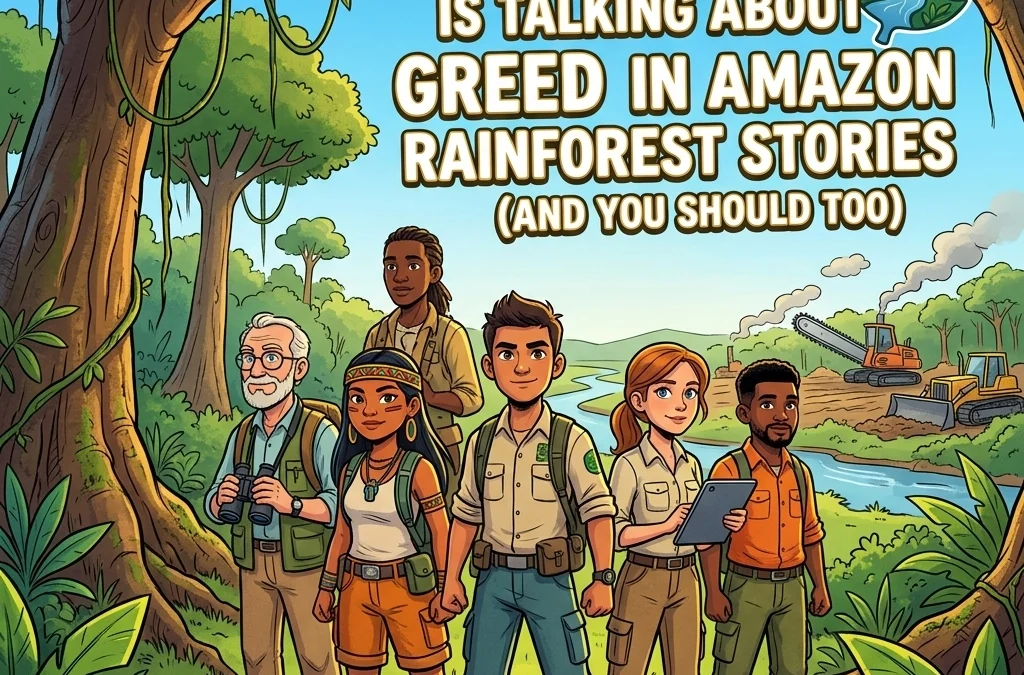
Meta Description: Explore why corporate greed is the ultimate villain in 2026 rainforest fiction. From Bossman's ruthless boardrooms to the real-world Amazon crisis, discover why The Rainsavers is the adventure series we need right now.
It’s May 2026, and if you’ve scrolled through any book community lately, you’ve probably noticed a massive shift in what makes our skin crawl. We’re moving away from the era of aliens and supernatural ghouls. Instead, the most terrifying thing in modern fiction doesn't have claws or fangs, it has a diversified portfolio and a corner office.
Welcome to the age of the "Eco-Villain."
In The Rainsavers universe, and across the growing genre of climate fiction, the antagonist isn't a "madman" in the traditional sense. They are calculated. They are polished. They are corporate. Specifically, everyone is talking about the looming shadow of corporate greed in the Amazon Rainforest, and honestly? It’s about time.
The Shift from Super-Villains to CEOs
For decades, adventure stories followed a pretty standard script: a bad guy wanted to blow up the moon or take over the world just because they were, well, bad. But as we navigate the environmental complexities of 2026, those motivations feel a little thin.
Today’s readers are looking for something that mirrors the world outside their windows. We’re seeing a rise in "Eco-Fiction" because the stakes are real. When we talk about the Amazon, we aren't just talking about a backdrop for a jungle chase; we’re talking about the lungs of our planet. And the people threatening those lungs aren't doing it for "evil" points: they’re doing it for the bottom line.
This is where the character of Bossman comes in. In our series, Bossman represents the most realistic: and therefore most terrifying: threat of the modern age. He isn't trying to destroy the world; he's trying to monetize its destruction. That subtle difference is what makes corporate-led stories so gripping in 2026.

ALT text: A cartoonized Bossman in a sleek, high-tech boardroom, analyzing holographic data and rainforest maps.
Why Corporate Greed is the Perfect Antagonist in 2026
Why does this resonate so much right now? Because corporate greed isn't a fantasy trope; it’s a structural reality. If you look at the state of the Amazon today, the destruction isn't accidental. It’s fueled by global demand for beef, soy, and minerals.
In The Rainsavers, we explore how this greed manifests through high-tech boardrooms and holographic stock tickers. While the heroes are on the ground, dealing with the heat, the insects, and the very real dangers of the jungle, the villain is sitting in a climate-controlled room thousands of miles away, moving digital markers across a map of the rainforest.
The "Eco-Villain" doesn’t need a cape. They have:
- Structural Impunity: They use "cattle laundering" and shell companies to hide where their profit comes from.
- High-Tech Surveillance: Using drones and satellites not to protect, but to find the next "unexploited" patch of land.
- A Lack of Empathy: To a character like Bossman, an ancient tree isn't a wonder of nature; it’s carbon credits or timber.
This clinical approach to destruction is why eco-fiction will change the way you think about adventure stories. It’s not just about a fight; it’s about a clash of worldviews.
The Realistic Terror of Bossman
Let’s talk about Bossman for a second. If you’ve been following our character bios at rainsavers.com/characters/, you know he’s a piece of work. He’s the personification of the "extraction model" of the 21st century.
In 2026, we’ve reached a tipping point where the Amazon is close to becoming a savanna if we don't act. Bossman knows this. But instead of stopping, he sees it as a scarcity play: the less rainforest there is, the more valuable the land he controls becomes. That’s the kind of logic that keeps you up at night. It’s the logic of profit over life, and it’s why characters like him are dominating the conversation in adventure fiction.
He often uses ancient technology vs. modern threats to get what he wants. He’ll take German WWII tech found in the deep jungle and repurpose it for modern deforestation. It’s a mix of history’s darkest moments and future tech’s coldest calculations.
How The Rainsavers Fight Back
If corporate greed is the ultimate villain, how do you even fight it? You can’t just punch a corporation in the face (though Primal might try). You have to fight it on every level: physically, digitally, and culturally.
Our team: The Rainsavers: is designed to tackle this multi-headed hydra:
- Sunbyte: As our hacker-nurse, she’s the one taking on the machines behind deforestation. She doesn't just fight soldiers; she fights algorithms and data streams that Bossman uses to hide his tracks.
- Alpha Orangenius: Because sometimes it takes the smartest non-human on the planet to see the flaws in human "logic." Meet Alpha Orangenius here.
- Jungle Dart: Representing the indigenous voice, he reminds us that the Amazon isn't just a "resource": it's a home.

ALT text: The Rainsavers team: Primal, Sunbyte, Alpha Orangenius, and Jungle Dart: standing together against a backdrop of the Amazon canopy.
Why You Should Be Talking About This Too
We often read fiction to escape, but the best fiction helps us process the things we’re afraid of. If you’re struggling with climate anxiety, seeing a team of heroes actually do something about corporate greed can be incredibly cathartic.
Everyone is talking about corporate greed in rainforest stories because we see it every day in the news. We see companies promising "net zero" while their actions on the ground say otherwise. We see the Amazon burning and we see the stock prices rising.
By engaging with these stories, we aren't just consuming entertainment. We’re participating in a cultural dialogue about what we value. Do we value the profit margins of a few "Bossman" types, or do we value the biodiversity and life of the planet?
The "Eco-Villain" is Here to Stay
The rise of the corporate villain in Amazonian stories reflects a maturing of the adventure genre. We’ve realized that the "monster" isn't in the woods: the monster is the one sending the bulldozers into the woods.
In The Rainsavers, we don't shy away from the gritty reality of 2026. We embrace it. We show the holographic maps, the stock tickers, and the ruthless boardrooms because that’s the reality of the fight. But we also show the courage, the tech, and the teamwork it takes to stand up to that greed.
So, next time you pick up a book and find yourself rooting against a CEO in a high-tech boardroom instead of a dragon in a cave, know that you’re part of a massive shift in how we tell stories. You’re looking the real threats of our time in the eye.
Are you ready to join the fight? Because Bossman is already making his next move, and the Amazon can't wait.
Stop the greed: Read Book One now.
https://rainsavers.com
