
Hey there, adventure seekers and plant parents! Steven G. Samuels here, CEO of The Rainsavers.
If you’ve been following our 6-book journey, you know that the Amazon isn't just a backdrop for our stories, it’s a living, breathing character. While Jungle Dart is busy swinging through the canopy and Sunbyte is busy hacking into logging mainframes, there’s one person who truly understands the heartbeat of the forest: Dr. Mubari.
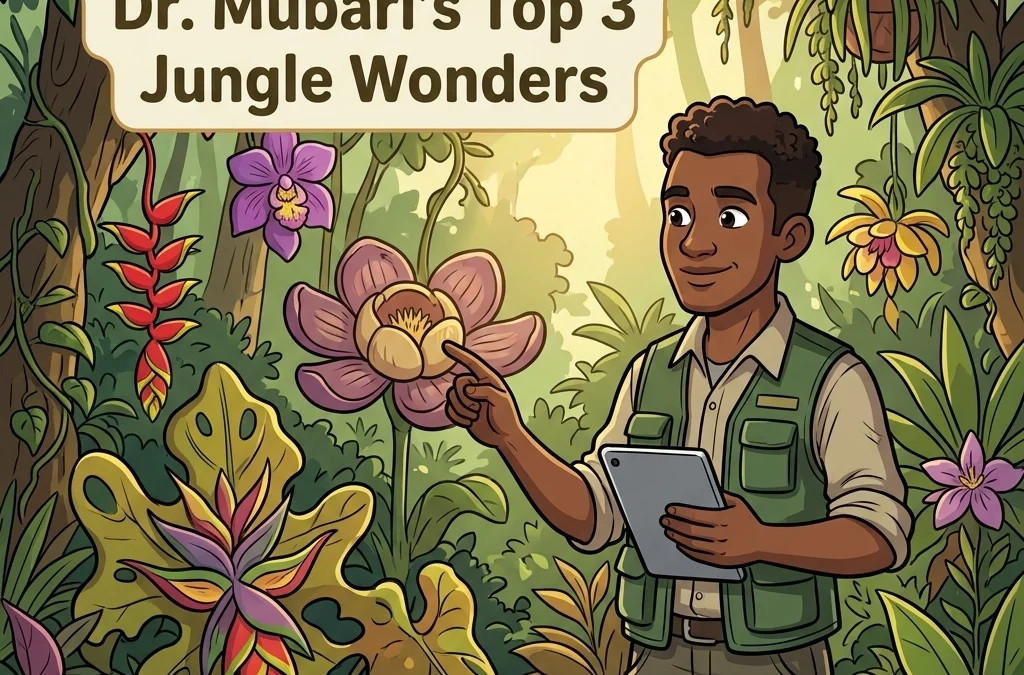
As our team’s resident ethnobotanist and chief "plant whisperer," Dr. Mubari is often the one who saves the day with a rare root or a well-timed extract. I sat down with her (virtually, of course, she's currently deep in the Xingu basin) to ask about her favorite Amazonian wonders.
Forget the standard roses and daisies. In the world of The Rainsavers, the plants have teeth, secrets, and sometimes even legs.
Here are Dr. Mubari’s top 3 jungle wonders that play a massive role in our series.
1. The Victoria Amazonica: The Queen of the Water
"If you ever find yourself needing a floating fortress," Dr. Mubari told me, "this is it."
The Victoria amazonica is the world’s largest water lily. We’re talking leaves that can grow up to 10 feet in diameter. In The Rainsavers, these aren’t just pretty pads; they are tactical assets. In Book 2, the team uses these massive leaves to transport equipment across a piranha-infested lagoon.
Why Dr. Mubari loves it:
- Structural Engineering: The underside of the leaf is a marvel of nature, featuring a rib-like structure that makes it incredibly strong. It can support the weight of a small child, or in our case, a very heavy crate of high-tech gear.
- The Scent: It blooms at night with a fragrance that smells like a mix of pineapple and butterscotch. But beware: it traps beetles inside its petals overnight to ensure pollination.
- Defense Mechanism: The undersides are covered in sharp spines. It’s nature’s way of saying, "Look, but don’t touch."

2. Socratea Exorrhiza: The Walking Palm
"People think plants are stationary," Mubari laughed. "The Socratea exorrhiza proves them wrong. It’s the ultimate survivalist."
Commonly known as the Walking Palm, this tree is famous for its unique root system. Instead of one solid trunk going into the ground, it has a "stilt" root system that looks like a bunch of legs. Legend (and some debated science) says the tree can "walk" away from shadows and toward the sunlight by growing new roots in the direction of the light and letting the old ones die off.
Why it’s a Rainsavers Wonder:
In our series, the Walking Palm is a symbol of the team’s adaptability. Just like The Rainsavers, the forest is always moving, shifting, and finding new ways to survive against modern threats.
Dr. Mubari often uses the concept of the Walking Palm to explain how the forest regenerates itself. When we face villains using ancient German technology to tear down the trees, the Walking Palm reminds us that nature is never truly defeated, it just moves.

3. Bauhinia Guianensis: The Monkey Ladder Vine
If you’ve read the chapters featuring Jungle Dart, you’ve seen this plant in action. The Monkey Ladder vine is exactly what it sounds like, a thick, wavy vine that looks like a staircase leading up into the clouds.
"This is the highway of the Amazon," Dr. Mubari explained. "Without these vines, the connectivity of the jungle would collapse."
The Science and the Fiction:
- Connectivity: These vines (lianas) connect the forest floor to the high canopy. They allow monkeys, jaguars, and our teen protector, Jungle Dart, to navigate the heights without ever touching the ground.
- Hydration: Some species of vines store fresh, drinkable water. In The Rainsavers, the team often relies on Dr. Mubari’s knowledge to find "water vines" when their supplies run low during a chase.
- Medicine: The bark of many Amazonian vines contains compounds that can treat everything from inflammation to fevers, skills Sunbyte often utilizes when the team is in a pinch.

Why Botany Matters in Eco-Fiction
You might be wondering: Steven, why are we talking so much about plants? I’m here for the explosions and the high-tech gadgets!
Well, that’s the thing. In modern eco-fiction, the environment is the gadget. While other series might give their heroes a magic belt or a laser sword, we give ours a deep understanding of the Amazonian ecosystem.
When Dr. Mubari identifies a specific fungus that can break down plastic or a plant extract that can jam a drone’s sensors, she’s showing that the real "superpower" is knowledge of the natural world. This is why we believe team-based adventures are taking over. No one person can save the planet. It takes a hacker, a powerhouse like Primal, a jungle expert, and a botanist working in perfect harmony.

Nature vs. Modern Threats
A recurring theme in The Rainsavers is the clash between ancient mysteries and modern threats. Our villains aren't just guys in suits; they are entities trying to replace the complex, beautiful "technology" of the Amazon with cold, destructive machinery.
Whether it's ancient technology being misused or corporate greed threatening the very plants Dr. Mubari loves, the stakes couldn't be higher.
The Amazon isn't just a place to visit; it's a place worth fighting for. And the more you know about wonders like the Walking Palm or the Queen of the Water, the more you realize what we stand to lose.
Join the Adventure
If you’re struggling with a bit of climate anxiety, jumping into a world where heroes actually make a difference can be a huge help. Our 6-book series is designed to be a binge-worthy thrill ride that leaves you feeling inspired rather than overwhelmed.
Want to learn more about the team or the amazing flora they protect? Dive into our Ultimate Guide to Climate Fiction or check out the full character bios over at rainsavers.com/characters.
The jungle is calling. Are you ready to answer?
Stay wild,
Steven G. Samuels
CEO, The Rainsavers
P.S. Don't forget to keep an eye out for our next field report! We might just let Alpha Orangenius take over the blog for a day. That should be… interesting.
Visit us at: https://rainsavers.com
