Look, we've all been there. Someone in a lab coat thinks, "What's the worst that could happen?" and then, boom, suddenly there's a bioweapon loose in the Amazon or someone's trying to patent the rainforest's DNA.
Welcome to 2026, where the best adventure stories don't start with aliens invading or ancient curses awakening. They start with a scientist who had one job and absolutely botched it.
Why Science Gone Wrong Hits Different in 2026
Here's the thing: we're living in a world where gene editing is real, AI is everywhere, and corporations are literally trying to own the building blocks of life. So when a thriller kicks off with "What if a pharmaceutical company stole indigenous plant DNA?" we don't think "That's wild sci-fi." We think "Yeah, that tracks."
The Rainsavers leans hard into this reality. The series doesn't need to explain why a villain would want to weaponize rainforest biology, because we all saw the news about biopiracy last year. The fiction just takes it one step further (okay, maybe several steps) and asks: What happens when the people trying to stop it are just as scientifically advanced as the bad guys?

The Formula That Actually Works
Most adventure stories in 2026 follow a tried-and-true pattern:
Step 1: Scientist discovers something incredible
Step 2: Corporation/Government/Shadowy Organization wants to exploit it
Step 3: Ethical scientist says "Absolutely not"
Step 4: Chase scenes through exotic locations ensue
Sound familiar? That's because it's the backbone of basically every eco-thriller hitting shelves this year, including The Rainsavers.
But here's where things get interesting: The best versions of this formula don't just stop at "science bad." They ask bigger questions. Who owns nature? What happens when profit motive meets ecological crisis? Can technology save us from… technology?
In The Rainsavers, the team isn't just fighting generic evil scientists. They're up against people who genuinely believe they're doing the right thing, even when they're stealing genetic material or developing weapons that could devastate entire ecosystems. That moral gray zone? That's what makes 2026's adventure stories hit harder.
Real Science Makes For Better Villains
Forget supervillains with death rays. The scariest antagonists in 2026 carry briefcases and have corporate expense accounts.
The Rainsavers nails this by basing its threats on actual scientific possibilities. Red mercury conspiracies, bioweapon development, genetic manipulation, none of it requires a suspension of disbelief because we're already halfway there in the real world.

When Primal and the team discover a plot to weaponize Amazonian biology, readers don't roll their eyes. They think, "Oh god, is this actually happening somewhere right now?"
That's the secret sauce. The science doesn't have to be 100% accurate (it's still fiction, folks), but it needs to be plausible enough that you finish a chapter and immediately want to google whether red mercury is real. (Spoiler: The rabbit hole goes deep.)
Why Rainforests Make Perfect Settings
There's a reason why so many 2026 thrillers are set in jungles, rainforests, and remote ecological hotspots. It's not just because they look cool in cover art (though they absolutely do).
Rainforests are literally treasure troves of undiscovered biology. Scientists estimate we've only catalogued a fraction of species living in places like the Amazon. Every tree, every plant, every weird bug could theoretically hold the key to medical breakthroughs, new materials, or, if you're writing a thriller, a terrifying bioweapon.
The Rainsavers uses the Amazon as more than just a backdrop. It's a character in itself, a place worth protecting, not just because it's pretty, but because it contains irreplaceable genetic information that corporations would absolutely love to patent and exploit.
And let's be real: chase scenes through dense jungle while dodging both mercenaries and jaguars? That's just good reading.
The Team-Based Difference
Here's where 2026's adventure stories break from the old formula: the lone hero is dead. Long live the team.
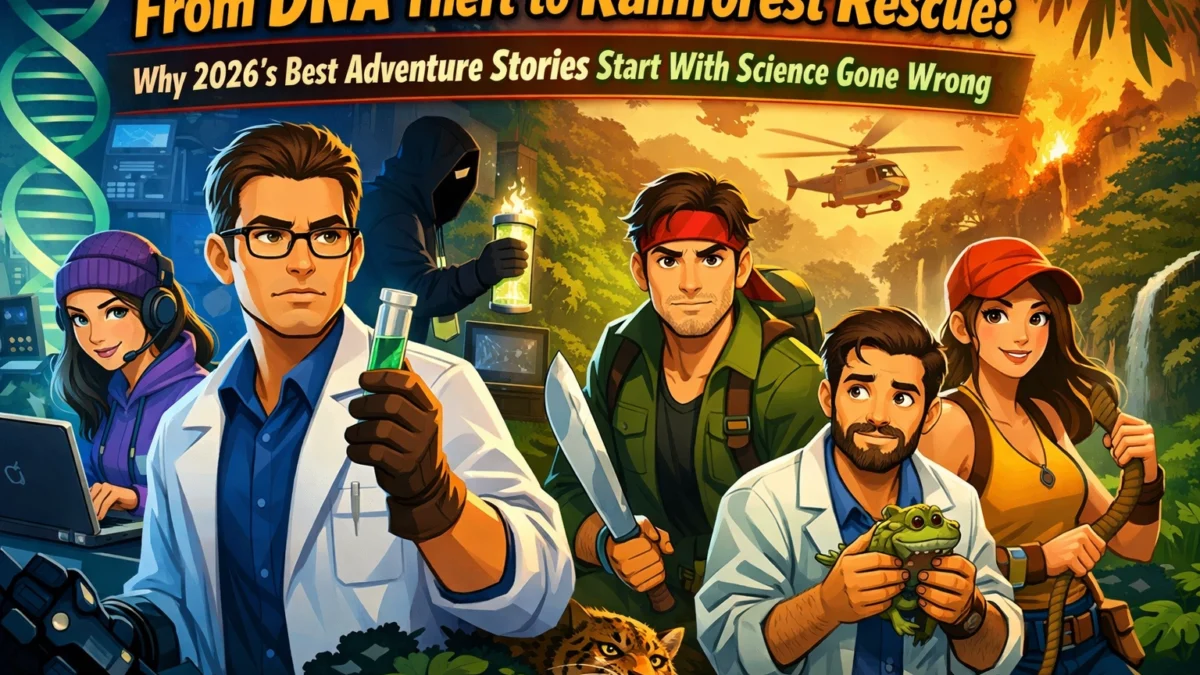
You can't solve DNA theft and ecological disasters with one person, no matter how rugged their jaw or mysterious their backstory. You need a biologist, a tech expert, someone who can actually navigate the jungle without getting lost, and probably a person who's really good at punching when negotiations fail.

The Rainsavers gets this. The team isn't just "main character plus sidekicks." Everyone brings specialized knowledge to the table. When they're racing to stop a bioweapon, it's not because one hero magically knows everything, it's because they're pooling expertise and covering each other's blind spots.
This mirrors real-world science, where breakthroughs come from collaboration, not lone geniuses. It also makes for way more interesting character dynamics when everyone's skill set is actually necessary.
When The "Oops" Moment Changes Everything
Every good science-gone-wrong story has that pivotal "oops" moment. The experiment that goes sideways. The sample that gets mishandled. The well-intentioned research that falls into the wrong hands.
In The Rainsavers, these moments aren't played for laughs (okay, sometimes they are). They're the catalyst for everything that follows. One small mistake, one overlooked security protocol, one scientist who thought they could handle something alone, and suddenly the team is racing against time to prevent catastrophe.
That's what makes these stories so compelling. The threats aren't abstract or otherworldly. They're frighteningly human. Someone made a choice, cut a corner, or prioritized profit over safety, and now heroes have to clean up the mess before it spirals into global crisis.
Why We Need These Stories Right Now
Look, 2026 is weird. We're dealing with climate change, corporate overreach, technological advancement that's outpacing ethics, and a general sense that maybe someone should've read more sci-fi before building that thing.
Adventure stories that start with science gone wrong aren't just entertaining, they're cautionary tales wrapped in action sequences. They let us explore worst-case scenarios in a safe space while rooting for characters who refuse to let greed and recklessness win.
The Rainsavers does this by balancing the thrills with genuine stakes. Yes, there are chase scenes and explosions and last-minute saves. But underneath it all is a question we should all be asking: Just because we can do something, does that mean we should?
Start Your Adventure
If you're ready for a series that combines cutting-edge science, environmental stakes, and a team of characters who actually know what they're doing (most of the time), it's time to dive into The Rainsavers.
Because the best adventure stories in 2026 don't wait for permission. They start with someone saying "This isn't right" and deciding to do something about it: corporate lawyers and bioweapons be damned.
Read Book One now and see why science gone wrong makes for the best kind of page-turner.
