
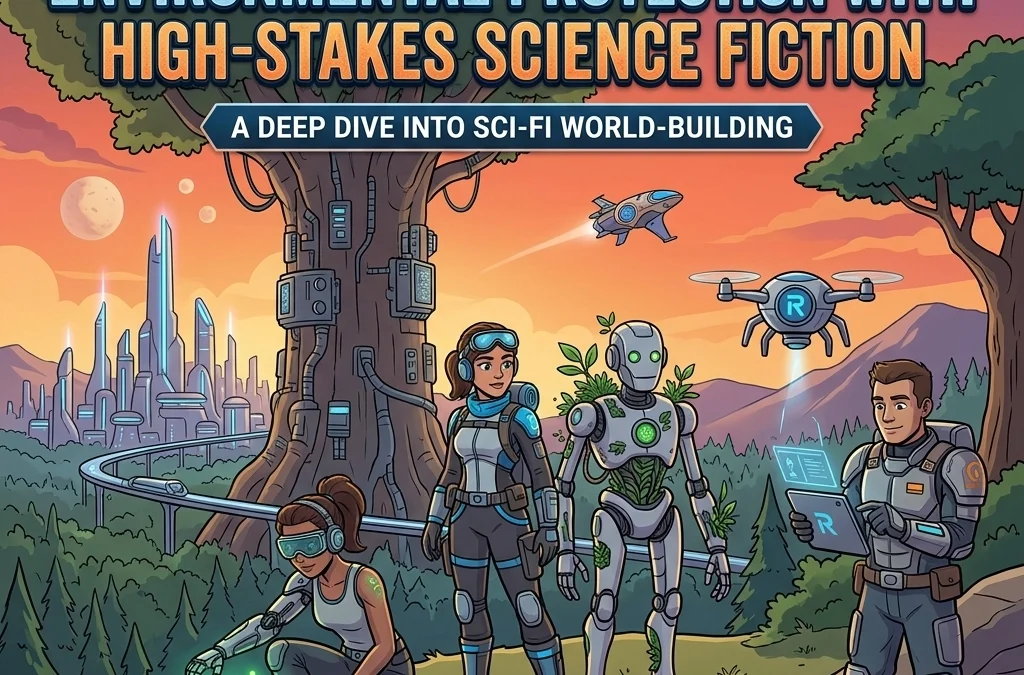
Meta Description: Want to save the planet without being a bore? Steven G. Samuels, CEO of The Rainsavers, breaks down how to blend hardcore environmental science with high-octane sci-fi gadgets like Red Mercury.
Hey there, eco-adventurers! Steven G. Samuels here, CEO and chief coffee-drinker at The Rainsavers. It’s Tuesday, March 31st, 2026, and the world is looking a lot different than it did a few years ago. People are asking me all the time: "Steven, how do you make a story about saving the environment feel like a summer blockbuster instead of a biology textbook?"
It’s a fair question. Let’s be honest: sometimes "environmental fiction" feels like being told to eat your broccoli while someone else is at a pizza party. But here at The Rainsavers, we don’t do boring. We do high stakes, weird tech, and characters who are more likely to kick a door down than file a permit.
Integrating real environmental protection into science fiction is an art form. It’s about taking the terrifying reality of our planet’s health and arming it with lasers, ancient mysteries, and a healthy dose of "what if?"
1. Ground the Threat in Real Science (Then Add the Spicy Stuff)
If you want the stakes to feel high, they have to feel real. In 2026, we all know what a two-degree Celsius shift feels like. It’s not just a number; it’s a lifestyle change. To make your sci-fi pop, you start with the real science of climate change: like solar geoengineering or biodiversity loss: and then you turn the dial to eleven.
Take our use of Red Mercury. Is it a real element found in the periodic table? Not exactly. But is it a fantastic narrative bridge for high-stakes energy crises? Absolutely. By grounding the "impossible" tech in the very real need for clean energy, the fiction feels urgent. It’s about taking the anxiety we all feel about the grid and giving it a face, a glow, and a countdown timer.

2. Characters Who Aren't "Perfect"
The biggest mistake in eco-fiction is making the heroes too saintly. Nobody wants to read about a hero who never drops a candy wrapper. We want people like Primal and Mortalis.
These aren't your typical caped crusaders. In fact, if you’re looking for why team-based adventure series are taking over, it’s because the environment is too big for one person to save. You need a crew. You need the tech genius who’s a bit too obsessed with ancient circuitry, and the muscle who’d rather be planting trees but is currently busy stopping a corporate meltdown.
When characters have conflicting motivations: one wants to save the whale, the other just wants to get paid so they can fix their ship: the environmental protection aspect becomes a hurdle they have to clear together. It adds friction, and friction makes for a great story.
3. Make the Environment the Ultimate "Boss"
In high-stakes sci-fi, the villain is often a guy in a suit or a rogue AI. But in The Rainsavers universe, the environment itself is a character. It’s unpredictable, it’s powerful, and it doesn’t care about your plans.
When you integrate real environmental protection, you aren't just "protecting" a passive forest. You're trying to stabilize a chaotic system that is fighting back. We love mixing historical mysteries with sci-fi because it shows that the planet has been through this before. Ancient civilizations had tech we’re only just rediscovering, and usually, they lost it because they didn't respect the balance.
That’s a high-stakes hook! It’s "Indiana Jones meets Blade Runner," but the prize isn't gold: it's a breathable atmosphere.
4. Field Notes: The "Oops" Files (March 2026 Edition)
Writing about high-tech eco-protection sounds cool until you realize how messy the "science" part can get. Here's a quick look at some of our "Field Notes" from the writing desk this week:
- The Carbon Scrubbing Incident: One of our writers tried to design a portable carbon scrubber for a character to wear. After three hours of research, we realized that for it to actually work in real-time, the backpack would need to be the size of a school bus.
- The Fix: We gave it a "Red Mercury core" and called it a day. Problem solved.
- The "Friendly" Fauna: We designed a genetically modified moss meant to clean river water. Then we realized that if it grew too fast, it would literally eat the character's boots while they were sleeping.
- The Fix: We kept it in! Nothing says high stakes like your shoes trying to photosynthesize you.
- The Atmospheric Drone Fail: I tried to write a scene where a fleet of drones creates a localized rainstorm. I accidentally described the physics in a way that would have created a vacuum that sucked the oxygen out of the room.
- The Fix: A lot of rewriting and a very funny scene where Mortalis gets a very high-pitched voice for five minutes.

5. Why Eco-Fiction Matters Right Now
We’re living in a time where climate anxiety is a real thing. Reading the news can feel like a punch to the gut. That’s why integrating these themes into science fiction is so vital. It allows us to process the "what if" scenarios without the paralyzing fear.
Adventure stories give us agency. They remind us that even when the threats are massive: like ancient technology waking up under the ice: human ingenuity and teamwork can turn the tide. If you’re wondering why eco-fiction will change the way you think about adventure, it’s because it moves the conversation from "we’re doomed" to "we’re going on a mission."
6. Tips for Balancing Action and Activism
If you're a reader or a budding writer looking to dive into this genre, here are a few tips to keep the balance:
- Show, Don't Preach: Don't tell the reader that pollution is bad. Show them a city where the sky is the color of a bruised plum and the rain smells like burnt rubber.
- Tech with Consequences: Every piece of high-stakes sci-fi tech should have a trade-off. If you use a device to cool the ocean, where does that heat go? (Hint: It usually goes somewhere it shouldn't, which starts the next chapter!)
- Local Stakes, Global Impact: Focus on one valley, one city, or one character's home. If they save that one thing, it represents the hope for the whole world.
- Use the Mystery: Ancient mysteries vs. modern threats is a classic trope for a reason. Use the past to warn about the future.
The Bottom Line
At The Rainsavers, we believe that the best way to protect our world is to fall in love with the adventure of it. Whether you're following our latest episodes or checking out our characters, you’ll see that the environment isn't just a background: it's the heart of the fight.
Integrating real environmental protection into sci-fi isn't about being "preachy." It's about recognizing that the greatest adventure of the 21st century (and the 22nd!) is the fight for our own home.

Want to Join the Adventure?
We’re always looking for more Rainsavers to join the fold. If you think you’ve got what it takes to navigate a world of Red Mercury and ancient eco-tech, dive into our world.
Ready to start your journey?
Explore the series and join the movement at https://rainsavers.com.
Don't forget to check out our latest TV commercial to see the action in motion, or cast your vote in our latest community poll to decide which piece of tech Primal should use in the next book!
Stay wild, stay curious, and keep saving those raindrops.
: Steven G. Samuels
CEO, The Rainsavers
