
Hey there, eco-adventurers! Steven G. Samuels here.
As we sit here in March 2026, looking back at the journey of The Rainsavers, it’s wild to see how much has changed. When we first started this six-book saga, our heroes were basically heading into the heart of the rainforest with little more than a sharp blade and a lot of grit.
If you’ve been following the series from the start, you know that the "field gear" has evolved faster than a digital virus in a corporate mainframe. We’ve gone from old-school survivalism to cutting-edge tech that feels like it’s pulled straight from a secret government lab.
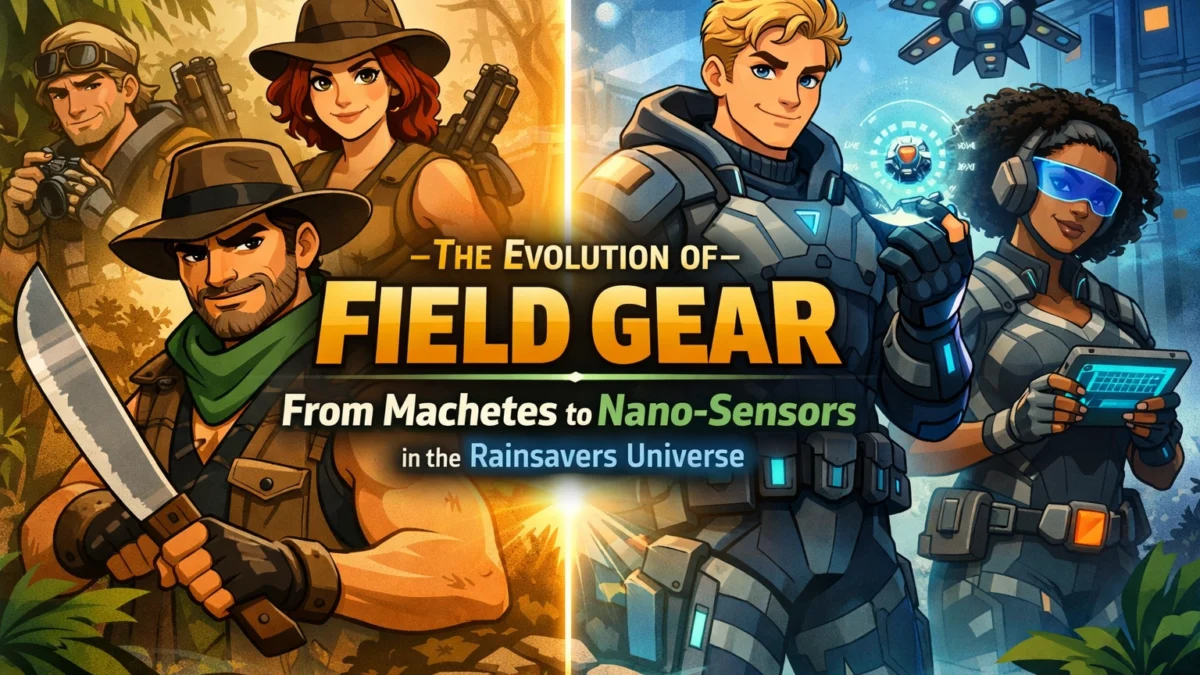
Let’s take a walk down memory lane: and a look into the high-tech future: to see how the Rainsavers went from hacking through vines to hacking through encrypted firewalls with nano-sensors.
The Humble Beginnings: The Machete Era
In the early chapters of our story, technology was more of a liability than an asset. If you’ve met Jungle Dart, the teen protector raised by the forest itself, you know his philosophy: if it needs batteries, it’s going to fail when the humidity hits 98%.
In the beginning, "field gear" meant:
- Carbon-Steel Machetes: Essential for clearing paths and, occasionally, warding off things that go bump in the night.
- Analog Compasses: Because GPS signals are non-existent under a triple-canopy roof.
- Boiled Leather and Canvas: Rugged, heavy, and smelled like a wet dog after two days.
This was the era of raw survival. The team relied on instinct and local knowledge. But as the threats evolved: moving from simple poachers to global conglomerates with private armies: the gear had to keep up.

Enter the Scientist: Mubari’s Tech Infusion
Everything changed when Mubari joined the crew. As the team’s lead scientist, he realized that the Rainsavers couldn't just hide in the shadows anymore; they needed to see what was coming before it arrived.
Mubari’s first major contribution was the Ruggedized Bio-Tablet. It wasn't pretty. It was thick, wrapped in shock-absorbent polymer, and could probably survive being stepped on by an elephant. But it allowed the team to start mapping the "invisible" threats: soil toxicity levels, illegal logging acoustic signatures, and migratory shifts caused by climate change.
This shift is a huge part of why eco-fiction is changing the way we think about adventure. It’s not just about the fight; it’s about the data.
The Sunbyte Revolution: Digital Guerrilla Warfare
By the time we hit the mid-point of the series, the gear took a massive leap forward thanks to Sunbyte. As a hacker-nurse, she brought a unique perspective: tech should be used to heal the planet and hurt the machines destroying it.
Sunbyte introduced the Signal-Flare Drones. These aren’t your hobbyist drones from the local mall. These are whisper-quiet, solar-rechargeable units that provide a "bird’s eye" view of the canopy.
But her real masterpiece? The Mesh-Network Scrambler. This piece of field gear allowed the Rainsavers to move through high-tech security zones without being detected by thermal or motion sensors. Suddenly, our heroes weren't just survivors; they were ghosts in the machine.

Powering Up: Primal’s Kinetic Storage Suit
We can’t talk about gear without mentioning Primal. When Tom Swift went through the "crash" that turned him into the team’s powerhouse, his needs changed. Traditional clothing just couldn't handle the sheer physical output he was capable of.
The Kinetic Storage Suit was developed to solve two problems:
- Durability: It’s made from a bio-synthetic weave that stretches and breathes but is tougher than Kevlar.
- Energy Harvesting: Every movement Primal makes generates kinetic energy, which is stored in micro-capacitors within the suit. This energy can then be used to power the rest of the team’s devices in the field. He’s literally a walking battery.
This kind of tech-heavy storytelling is exactly why team-based adventure series are taking over in 2026. One person can't carry all that gear, but a team? They’re a mobile base of operations.
The Genius Touch: Alpha Orangenius and the Ape-Interface
One of the coolest (and weirdest) evolutions in our gear history involves Alpha Orangenius. How do you give a genius orangutan the tools he needs to help a human team?
You build the Neural-Link Gauntlet. This piece of gear fits over Alpha’s forearm and translates complex sign language and tactile inputs into digital commands. It allows him to interface with the team’s comms and even take control of remote sensors. It’s a bridge between species, built out of silicon and soul.

2026: The Age of Nano-Sensors
Now, as we move into the latest installments of the series, we’ve reached the pinnacle: Nano-Sensors.
We’ve moved past the need for bulky equipment. The Rainsavers now utilize "Dust-Tech": microscopic sensors that can be scattered over an entire valley. These sensors communicate via a bio-luminescent network, sending real-time data on:
- Chemical imbalances in the water.
- The presence of heavy machinery miles away.
- The heartbeat of the forest itself.
It’s a far cry from a machete, right? But here’s the thing: even with all this tech, the core mission remains the same. Whether they’re using a blade or a nano-bot, the characters are fighting for the same thing: the survival of our planet.
Why the Tech Matters
You might be wondering: "Steven, is this still a jungle adventure or is it sci-fi?"
The answer is both. In the Rainsavers universe, we love mixing historical mysteries with modern sci-fi. The evolution of the gear reflects the evolution of the threat. You can't fight a 21st-century villain with 19th-century tools.
But we always make sure the tech feels real. It breaks. It gets muddy. It runs out of juice at the worst possible moment. That’s what keeps the stakes high and the adventure grounded.

Final Thoughts: The Gear is Only as Good as the Hero
At the end of the day, a nano-sensor is just a piece of hardware. It’s the person (or orangutan) holding it that makes the difference. Whether it’s Lina Solimar hacking a satellite or Jungle Dart using a vine to set a trap, the gear is just an extension of their will to protect the wild.
If you’re struggling with a bit of climate anxiety, seeing these heroes use every tool at their disposal: from the ancient to the futuristic: is a great way to feel empowered.
See the gear in action by diving into the latest book in the series. The jungle is waiting, and we’ve got the tech to help you survive it.
Stay wild,
Steven G. Samuels
CEO, The Rainsavers
